
Why Choose a Cleanroom Chiller System?
A Cleanroom Chiller System helps hold process temperatures steady when equipment, people, and outdoor conditions change the room’s heat load. In a pharmaceutical suite, that may mean keeping chilled water stable while production equipment runs and doors open for material transfer. The chiller also supports humidity control and reliable operation of air-handling equipment. It is not a substitute for suitable filtration, airflow design, or monitoring.
MarketsandMarkets estimated the cleanroom technology market at USD 6.5 billion in 2023 and projected USD 10.5 billion by 2028. This is a market forecast, not evidence that every facility needs the same cooling design. Lawrence Berkeley National Laboratory building-energy expert Dale Sartor has emphasized measurement-led efficiency in his work. A useful paraphrase for cleanroom projects is: “Measure the load before sizing the cooling plant.” Treat that as a design principle, not a verified verbatim quotation. Actual loads depend on process equipment, room classification, occupancy, and operating schedules. A chiller selected from floor area alone can be poorly matched. Oversizing may increase cycling; undersizing can threaten temperature stability during peak demand. Ask for logged load data, operating limits, and a commissioning plan. Then compare energy use and redundancy needs. The details matter. Even a careful design deserves review after the room is running.
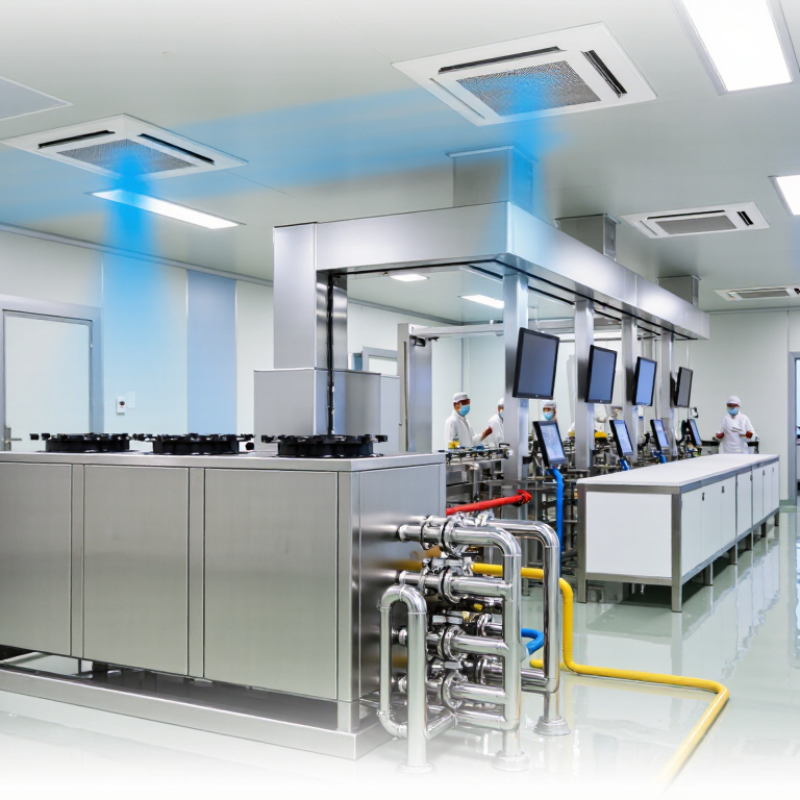
What Is a Cleanroom Chiller System?
A cleanroom chiller system removes heat from chilled water and circulates it to equipment that cools the room. Its main parts typically include a chiller, pumps, pipes, and air-handling coils. Warm air passes over the coils, transferring heat to the water. The chiller then rejects that heat outside the controlled space. The loop runs again.
This system supports stable conditions, but it does not control cleanliness by itself. Filters, airflow patterns, pressure relationships, and room controls also matter. A chiller may help maintain temperature, while humidity control often depends on the wider air-conditioning design. Small changes in equipment heat output can affect room conditions. That matters. A technician may check supply-water temperatures, pump operation, and coil performance during routine inspections. Condensation on a pipe or coil can signal that insulation or control settings need attention.
The right arrangement depends on the cleanroom’s process, heat load, operating schedule, and required environmental limits. Some facilities use dedicated loops; others share chilled-water infrastructure. In practice, the arrangement is not always elegant. Shared systems may be efficient, yet they can make troubleshooting less direct. Design decisions should be based on measured loads and documented requirements, not room size alone. A qualified HVAC engineer can assess these factors and coordinate the chiller with the cleanroom’s ventilation and control systems.
| Dimension | What It Is or Does | Why It Matters in a Cleanroom | Practical Design Consideration |
|---|---|---|---|
| System definition | A cleanroom chiller system removes heat from a water or water-glycol loop. The chilled fluid supplies cooling coils in air-handling units or other process equipment. | It provides controlled cooling for the room’s air-conditioning system and, where required, temperature-sensitive equipment. | Chillers are one part of the HVAC system; they do not independently create or maintain a cleanroom classification. |
| Temperature control | The chiller cools circulating fluid, while coils, valves, sensors, and controls help regulate the temperature of supply air and the space. | Stable temperatures can support product, process, and equipment requirements. | Setpoints and allowable variation should be based on the process and room specification, not a universal cleanroom temperature. |
| Humidity management | Cooling coils can remove moisture when air is cooled below its dew point. Reheat or other humidity-control equipment may also be needed. | Humidity can affect materials, processes, personnel comfort, and electrostatic behavior. | A chiller alone does not guarantee humidity control. Design should account for outdoor air, latent loads, coil conditions, and control strategy. |
| Particle cleanliness | The chiller provides cooling; filtration and cleanroom airflow systems handle airborne particle control. | Separating these functions helps ensure that cooling equipment is not mistaken for a particle-removal system. | Use appropriate air filtration, airflow patterns, room pressure relationships, and validated operating procedures for the required cleanliness level. |
| Heat-load capacity | Chiller capacity is selected to meet the calculated cooling load from equipment, lighting, people, envelope heat gain, ventilation, and process requirements. | An undersized system may struggle to meet conditions; an oversized system can cycle or operate inefficiently if not properly controlled. | Base sizing on a documented load assessment and expected operating conditions rather than floor area alone. |
| Temperature resilience | Controls monitor operating conditions and can adjust chiller output or chilled-water flow to respond to changing demand. | Responsive control can help maintain specified room conditions as process and occupancy loads change. | Define alarm thresholds, sensor locations, control sequences, and response procedures as part of commissioning. |
| Reliability and redundancy | Multiple chillers, pumps, or other standby components can be arranged to provide backup capacity, when required. | Redundancy can reduce the impact of equipment failure or maintenance on critical operations. | Determine whether N+1 or another redundancy approach is appropriate through a risk assessment and continuity requirements. |
| Energy performance | Chiller efficiency depends on equipment design, operating load, chilled-water temperatures, heat-rejection conditions, and system controls. | Cooling can be a significant facility energy use, so efficient operation can help reduce energy demand. | Compare performance at relevant operating conditions and assess the complete system, including pumps, cooling towers where applicable, and controls. |
| Maintenance and monitoring | Routine work may include inspecting components, checking fluid conditions, cleaning heat-transfer surfaces, and reviewing alarms and trends. | Preventive maintenance helps identify performance issues before they affect controlled conditions. | Set maintenance intervals according to equipment documentation, site conditions, and the facility’s quality and operational procedures. |
| Best-fit applications | Chilled-water systems are commonly considered for facilities with substantial or continuous cooling loads, multiple air handlers, or centralized cooling needs. | A central system can serve several loads, while other cooling approaches may suit smaller or specialized applications. | Compare lifecycle cost, available space, heat-rejection options, water use, service access, and applicable building requirements before selection. |

Certified Quality System

 Find Your Solutions ▶
NORTH EASTON MACHINE • 218 Elm Street • North Easton, MA 02356 • 508-238-6219