
Why Choose a Sewer Line Cleaning Machine?
Why Choose a Sewer Line Cleaning Machine?
A Sewer Line Cleaning Machine gives plumbing professionals a controlled way to clear blockages, restore flow, and inspect difficult underground lines. Instead of relying only on manual tools, technicians can select cables, cutters, or water-powered equipment for specific conditions. Grease, roots, scale, and compacted debris each require a different response.
Roger Wakefield, a licensed master plumber and plumbing educator, has emphasized, “Preventive maintenance is always cheaper than emergency repair.” That practical idea explains the machine’s value. A scheduled cleaning can help reduce foul odors, slow drains, repeated backups, and costly excavation. It also gives technicians a chance to observe warning signs before a small restriction becomes a serious failure.
The work is physical and technical. A trained operator must match the machine’s torque, cable size, and cutting head to the pipe. Protective equipment matters. So does careful inspection around fragile or aging lines. One mistake can worsen the damage.
No machine solves every sewer problem.
That assumption deserves reflection. A powerful cutter may remove roots temporarily, but it cannot repair a collapsed pipe. A high-pressure unit may clean efficiently, yet poor handling can damage weak connections. Reliable results depend on experience, accurate diagnosis, routine maintenance, and honest recommendations. For contractors and facility managers, choosing a Sewer Line Cleaning Machine means choosing better control, safer procedures, and a more informed approach to long-term drainage maintenance.
What Is a Sewer Line Cleaning Machine?
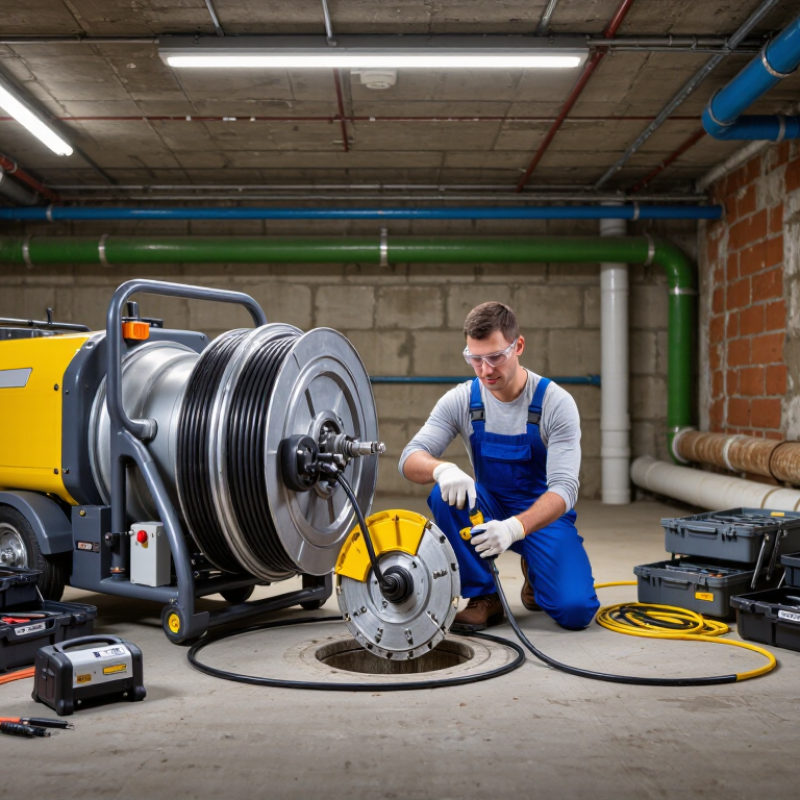
A sewer line cleaning machine is equipment designed to remove blockages from underground wastewater pipes. Most models use a powered rotating cable, often called an auger, that travels through the pipe. Interchangeable cutters break apart roots, grease, paper, and compacted debris. The loosened material then moves toward an access point for removal or flushing.
A typical machine includes a motor, cable drum, guide tube, foot switch, and protective gloves. Experienced technicians select the cutter according to the pipe diameter and blockage type. A small blade may clear soft grease, while a larger root cutter needs steady pressure and careful control. The cable can snag or twist when pushed too aggressively. That mistake is common, even among trained workers.
Not a magic fix.
Cleaning machines restore flow, but they do not repair cracked, collapsed, or badly displaced pipes. I have found that a line may appear clear while damaged sections continue collecting debris. For reliable work, operators should inspect the cable, test the ground-fault protection, and keep loose clothing away from moving parts. Camera inspection after cleaning can reveal hidden problems and confirm the pipe is open. Results also depend on pipe material, access depth, and the operator’s judgment.
| Data Dimension | Typical Information | Why It Matters | Best-Suited Applications |
|---|---|---|---|
| Definition | A sewer line cleaning machine is mechanical equipment used to remove blockages, buildup, roots, and debris from drainage and sewer pipes. | It restores water flow without immediately replacing the pipe. | Residential drains, commercial wastewater lines, municipal sewers, and industrial drainage systems. |
| Primary Cleaning Methods | Cable machines use a rotating steel cable, jetting machines use pressurized water, and sectional rod machines use connected rigid rods. | Different methods suit different pipe conditions, blockage types, and access points. | Localized blockages, grease buildup, sediment, tree-root intrusion, and long pipe sections. |
| Common Pipe Diameter Range | Portable cable machines commonly serve smaller lines of approximately 40–150 mm, while larger jetting and rod systems can clean pipes from approximately 100 mm to more than 600 mm. | The machine must match the internal pipe diameter to clean effectively and avoid pipe damage. | House drains, building laterals, storm drains, sewer mains, and industrial pipelines. |
| Typical Cleaning Reach | Portable cable equipment often reaches approximately 15–30 m, while sectional rods and high-pressure jetting systems can cover substantially longer distances depending on configuration. | Reach determines whether technicians can access the blockage from one opening or need additional access points. | Short indoor branches, building laterals, long underground sewer runs, and maintenance networks. |
| Typical Blockages Removed | Hair, paper, grease, sludge, scale, sand, small objects, roots, and compacted organic matter. | Identifying the blockage helps operators select the correct cutting head, nozzle, cable, or rod. | Kitchen lines, bathroom drains, wastewater pipes, stormwater systems, and process drains. |
| Water Jetting Pressure | Professional sewer jetting equipment commonly operates across a broad range, often from about 70 bar to more than 250 bar, depending on pipe size and cleaning requirements. | Higher pressure is not always better; excessive pressure can damage fragile or deteriorated pipes. | Grease removal, silt flushing, descaling, root cleaning, and preventive maintenance. |
| Main Power Options | Machines may be powered by electric motors, gasoline or diesel engines, hydraulic systems, or vehicle-mounted power units. | Power selection affects portability, operating environment, noise, ventilation needs, and cleaning capacity. | Indoor service work, outdoor maintenance, construction sites, municipal operations, and industrial facilities. |
| Portability | Compact electric cable machines can be carried or transported by one operator, while trailer-mounted and truck-mounted units provide higher capacity but require vehicle access. | Portable equipment is useful where access is restricted, while larger units reduce cleaning time on extensive networks. | Basements, narrow service areas, streets, parking areas, manholes, and large maintenance yards. |
| Cleaning Efficiency | Mechanical cleaning can remove a blockage directly, while water jetting can also flush loosened debris from the pipe wall. | Effective cleaning improves flow and can reduce repeat blockages when the underlying buildup is removed. | Emergency response, scheduled maintenance, recurring blockage control, and pre-inspection cleaning. |
| Preventive Maintenance | Routine cleaning intervals vary from several months to several years, depending on pipe age, usage, grease load, root growth, and previous blockage history. | Planned cleaning can identify developing problems before they cause overflow or service interruption. | Restaurants, apartment buildings, hospitals, factories, public drainage systems, and older properties. |
| Inspection Compatibility | After cleaning, a CCTV drain camera can be used to inspect cracks, displaced joints, corrosion, root entry, deformation, and remaining deposits. | Cleaning removes obstructions, while inspection helps determine whether structural repair is required. | Problem diagnosis, maintenance planning, property surveys, and post-cleaning verification. |
| Key Benefits | Faster blockage removal, reduced excavation, improved flow, flexible equipment selection, and better access to underground pipes. | Mechanical cleaning is often less disruptive than immediately excavating or replacing a sewer line. | Emergency repairs, routine service, commercial maintenance, and municipal sewer management. |
| Important Selection Factors | Pipe diameter, pipe material, blockage type, access location, required reach, power supply, water availability, operator safety, and waste handling. | Correct selection improves cleaning results and reduces the risk of damaging the pipe or surrounding property. | Every application should be assessed before choosing cable, rod, jetting, or combination equipment. |
| Safety Considerations | Operators should use suitable gloves, eye protection, protective clothing, hearing protection, electrical safeguards, and confined-space procedures where applicable. | Sewer work may involve contaminated water, rotating components, high-pressure water, gases, and unstable access areas. | Professional drain cleaning, municipal work, industrial sites, and confined-space operations. |
| Environmental Considerations | Collected debris, wastewater, grease, and sediment should be contained and disposed of according to applicable local requirements. | Proper waste management prevents contamination and keeps cleaning operations compliant. | Commercial premises, public infrastructure, industrial facilities, and sensitive environmental areas. |
| When to Choose a Machine | A sewer line cleaning machine is appropriate when plunging or chemical treatments cannot clear the blockage, when blockages recur, or when buildup must be removed from the pipe wall. | Mechanical cleaning provides a more controlled and repeatable solution for persistent drainage problems. | Recurring backups, slow drainage, foul odors, root intrusion, grease accumulation, and planned pipe maintenance. |

Certified Quality System

 Find Your Solutions ▶
NORTH EASTON MACHINE • 218 Elm Street • North Easton, MA 02356 • 508-238-6219