
Top Sides Spray Retort Manufacturers in China?
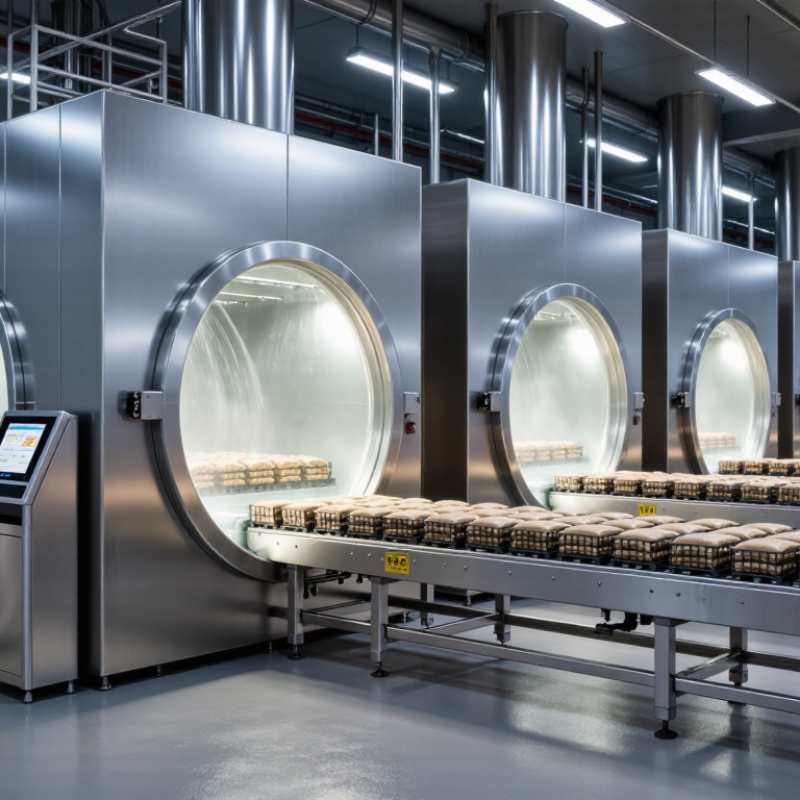
China’s Sides Spray Retort manufacturers serve food processors seeking consistent heating, reliable throughput, and practical equipment support. These systems spray heated water across packaged products while rotating or moving baskets through a controlled cycle. Picture sealed pouches passing through a warm, misted chamber. Small differences in loading, spray coverage, or temperature recovery can affect the finished product.
The stakes are measurable. FAO’s 2023 food-loss assessment estimated that 13.2% of food was lost between harvest and retail worldwide. Shelf-stable processing cannot solve every loss, but dependable thermal equipment can support safer storage and reduce avoidable spoilage. PMMI’s 2024 State of the Industry report also offers useful context on packaging-sector investment and operating pressures. Buyers should still compare verified process data, not brochure claims alone.
Selection takes scrutiny. Review temperature uniformity, basket capacity, controls, maintenance access, and documented validation support. Ask manufacturers for references using similar products and packaging formats. Dr. Dennis R. Heldman is a recognized food-engineering authority whose published work addresses thermal processing and food safety. However, no traceable direct quotation from him about Sides Spray Retort equipment is available in the material provided, so attributing one would be unreliable. That gap matters. A credible comparison of China’s leading suppliers should distinguish documented performance from sales language—and admit where evidence remains incomplete.
What Is a Side-Spray Retort and How Does It Work?
A side-spray retort is a pressure vessel that heats sealed food packages using hot water distributed through side-mounted spray nozzles. Rather than immersing every package, it directs water across the load while circulation helps reduce temperature differences. The vessel may also use controlled air pressure to protect pouches or trays from swelling during heating and cooling. It is practical, but not self-correcting.
Operators load baskets, close and check the vessel, then run a programmed cycle. Water is heated and sprayed over the packages; sensors track process temperature while pressure and circulation are controlled. During the holding stage, the product receives its scheduled heat treatment. Cooling water then lowers package temperature, with pressure maintained as needed to prevent deformation. Small details matter. A blocked nozzle, uneven basket spacing, or overloaded rack can create colder areas that heat more slowly.
The retort itself does not prove that every product is consistently processed. Process settings should be established and validated for the specific recipe, package size, loading pattern, and equipment. Temperature-distribution and heat-penetration studies help identify the slowest-heating location. Keep cycle, calibration, maintenance, and deviation records. Investigate irregular readings rather than assuming they are harmless. One awkward truth: a neat display reading can hide a poor spray pattern. Good operation depends on measurement and review, not appearance alone.
Top Side-Spray Retort Manufacturers in China? – What Is a Side-Spray Retort and How Does It Work?
This table summarizes side-spray retort technology and practical criteria for evaluating manufacturers. It does not rank suppliers or identify companies; equipment capability and process suitability should be confirmed for the specific product and package.
| Category | Dimension | Technical details | What to verify with a manufacturer |
|---|---|---|---|
| Definition | Side-spray retort | A batch retort that distributes heated water over the product load through spray nozzles, commonly arranged along the sides of the vessel. | Nozzle layout, spray coverage, load arrangement, and evidence of temperature distribution testing. |
| Heating system | Water circulation and heating | A pump recirculates process water through the spray system. Water is heated directly or through a heat exchanger, depending on the equipment design. | Heating method, pump capacity, flow monitoring, heat-exchanger design, and cleaning access. |
| Typical operating sequence | Loading to cooling | The vessel is loaded and closed; air is removed or controlled as required; the load is heated, held for the scheduled process, and then cooled under controlled conditions. | Documented cycle stages, automatic controls, alarms, recipe management, and batch records. |
| Pressure control | Counterpressure | When processing flexible pouches or other pressure-sensitive packages, compressed air may be used to balance internal package pressure during heating and cooling. | Pressure-control accuracy and compatibility with the package, seal, and product process. |
| Product safety | Time and temperature | There is no single time-and-temperature schedule suitable for every food. The required process depends on product properties, container size and material, loading pattern, and the validated process. | Process-authority review, calibrated sensors, temperature-distribution and heat-penetration study requirements, and traceable records. |
| Package compatibility | Containers and loading | Retorts may be configured for suitable cans, glass containers, trays, or flexible pouches. Compatibility depends on vessel design, baskets or racks, package limits, and process conditions. | A trial using the intended package, loading pattern, and product; package deformation and seal-integrity checks. |
| Construction and compliance | Pressure vessel and controls | The pressure vessel, instrumentation, safety devices, and control system should be designed and supplied in accordance with applicable local regulations and the intended installation requirements. | Applicable certificates, vessel documentation, safety-valve records, instrument calibration, and inspection or service support. |
| Supplier evaluation | Capability and lifecycle support | A suitable supplier should be assessed on engineering fit, documented testing, workmanship, controls, commissioning, training, spare parts, and after-sales service—not on a generic ranking alone. | Request a technical proposal against your product, package, target capacity, utilities, applicable standards, and validation plan. |
Note: A retort manufacturer supplies equipment; the scheduled thermal process must be established and validated for the specific product and package by appropriately qualified professionals.

Certified Quality System

 Find Your Solutions ▶
NORTH EASTON MACHINE • 218 Elm Street • North Easton, MA 02356 • 508-238-6219