
Top Insulated Metal Panel Manufacturers in China
China has a broad insulated building-products sector, and its manufacturers vary in scale, product focus, and export experience. This guide to top insulated metal panel manufacturers in China is intended to help buyers compare suppliers, not treat a ranking as proof of quality. Insulated Metal Panels combine metal facings with an insulating core, so core type, panel thickness, joint design, and coating can all affect performance. The right choice depends on the building, local climate, and project requirements.
Look beyond a polished brochure. Ask for current technical data, test reports relevant to your project, production quality-control details, and references for comparable installations. Check how the supplier handles panel dimensions, color consistency, lead times, packaging, and replacement parts. A sample can help reveal coating texture and joint fit, though it cannot confirm long-term performance on its own. Details matter.
Buyers should also clarify who provides design coordination, installation guidance, and after-sales support. Confirm warranty terms in writing, including what is covered and how claims are handled. Standards and certification needs differ by market, so verify that documents match the intended application rather than assuming every certificate applies everywhere. No single manufacturer suits every project. Even a strong shortlist may need another review once shipping, installation conditions, and building details are considered. The profiles below offer a practical starting point for that comparison.
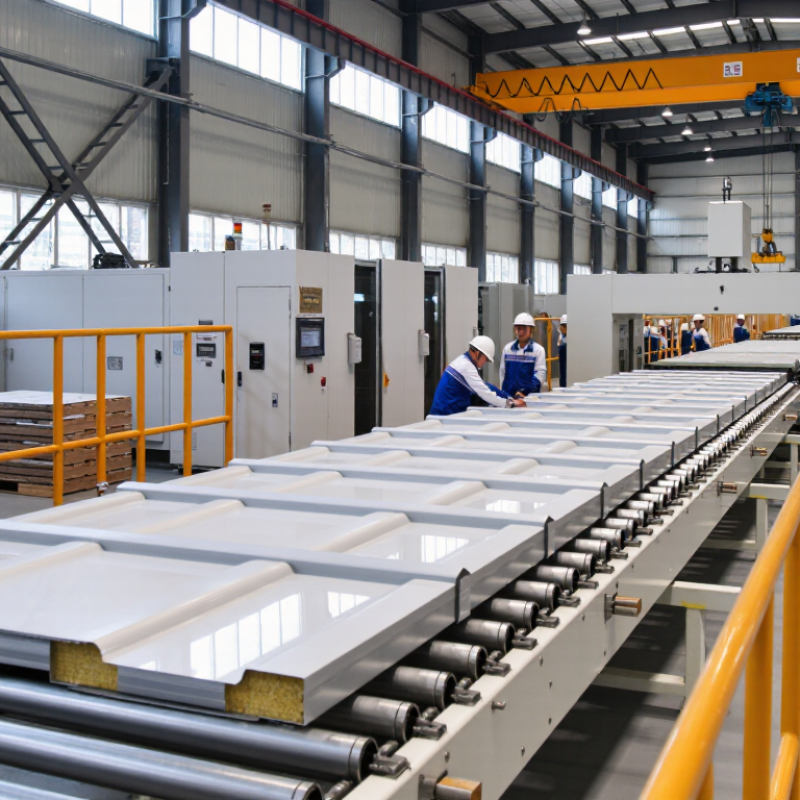
Insulated Metal Panels in China: Steel Skins, Core Types and 50–200 mm Thickness
China’s insulated metal panels pair galvanized or coated steel skins with a bonded insulation core. Common core choices include polyisocyanurate, mineral wool, and expanded polystyrene. Each behaves differently: PIR offers strong thermal resistance at lower thicknesses, while mineral wool is often selected for fire and acoustic considerations. ASHRAE’s Handbook—Fundamentals (2021) lists typical conductivity ranges that vary with material density and test conditions; approximate values are 0.022–0.026 W/m·K for PIR and 0.034–0.045 W/m·K for mineral wool. Small differences matter. A 100 mm core can therefore produce notably different nominal thermal resistance depending on its composition.
Chinese suppliers commonly offer panel thicknesses from about 50 to 200 mm for cold rooms, factories, and logistics buildings. The right selection depends on temperature targets, span, joint design, and local climate—not thickness alone. The 2023 Global Status Report for Buildings and Construction by UNEP and GlobalABC estimates that buildings and construction accounted for 37% of global energy- and process-related CO₂ emissions in 2022, underlining the value of effective envelopes. Still, a reported core value is not whole-wall performance. Steel joints, fasteners, and installation gaps can create thermal bridges. Not just thickness. Ask for tested panel data, core density, skin coating details, and declared U-values. A caveat remains: nominal specifications can look precise, while site workmanship is less predictable.

Core Conductivity: PIR 0.020–0.026 vs Mineral Wool 0.035–0.045 W/m·K
Thermal conductivity changes how much insulation a panel needs for a given target. PIR commonly falls around 0.020–0.026 W/m·K, while mineral wool is often near 0.035–0.045 W/m·K. These are typical declared-product ranges, not guarantees for every panel. At equal thickness, lower conductivity generally means greater resistance to heat flow. Small differences matter. A 100 mm core, for example, can perform differently depending on its tested value, joints, and installation.
For Chinese panel manufacturers, compare declared values with independent test results, not just brochure claims. EN 13165 covers factory-made rigid polyurethane insulation products, including PIR; EN 13162 covers mineral wool products. EN 12667 describes laboratory methods for measuring thermal resistance and conductivity. These standards help make product data comparable, but they do not make a complete wall or roof equally efficient. Metal facings, fasteners, panel joints, and air leakage also affect real performance. On a cold morning, a poorly sealed joint can matter more than a small difference in core conductivity. I would not choose a panel by lambda alone. The lower number is useful, but it is not the whole answer.
How Chinese IMPs Are Made: Coil Forming, Bonding and GB/T 23932-2009
Chinese insulated metal panels begin as coated steel coils. Uncoilers feed the strip through leveling rolls, then successive forming stands press ribs and edge details into each facing. Operators check coating damage, panel width, and profile depth before the sheets reach the bonding line. Small defects matter.
Depending on the core and production line, metered adhesive or foaming chemicals join the facings to mineral wool or foam insulation. Pressure belts hold the assembly straight while the bond sets. Quality checks can include thickness measurements, visual inspection, and bond or peel tests. GB/T 23932-2009, the Chinese national standard for building metal-faced sandwich panels, provides a framework for product classification, requirements, testing, and inspection. Buyers should compare test records with the standard and project specifications; a certificate alone does not show how consistently a line performs.
The energy context is significant. The International Energy Agency’s 2023 Global Status Report for Buildings and Construction reports that buildings use about 30% of global final energy and produce 26% of energy-related emissions. That makes insulation quality consequential, but panel performance depends on more than the core’s stated value. Seams, cut edges, and installation details can undermine it. Factory bonding is controlled, yet field joints remain a weak point worth checking.
Top Insulated Metal Panel Manufacturers in China — How Chinese IMPs Are Made
Typical bonded-panel production sequence and the role of GB/T 23932-2009
Bars show production order, not process duration or output. A typical line profiles metal facings, prepares and bonds or foams the core, presses and cures the panel, then cuts and inspects it. The exact route varies by panel system. GB/T 23932-2009 covers metal-faced sandwich panel requirements and test methods; it does not prescribe one universal production sequence.
Top Chinese Manufacturers by Product Range, Capacity and Project Record
For insulated metal panel suppliers in China, product range matters more than a long catalogue. Check whether a factory offers roof and wall panels, multiple core materials, usable thickness options, and compatible flashings. On a sample, inspect joint fit, cut edges, coating consistency, and exposed core. These details affect installation and weather sealing.
Capacity claims need context. Ask for operating lines, shifts, routine output, and current lead times—not only nameplate capacity. A large figure may exclude maintenance or seasonal demand. UNEP and the Global Alliance for Buildings and Construction reported that buildings and construction used 34% of global energy and produced 37% of energy- and process-related CO₂ emissions in 2022. This is sector-wide data, not a panel performance rating; it makes verified thermal specifications especially relevant.
Project records show whether a supplier can deliver consistently. Request examples by application, such as cold storage, workshops, or logistics buildings, and check panel spans, thicknesses, and delivery scale. Where possible, confirm references and compare drawings with installed details. A polished project list is not proof by itself. I would also ask how defects and replacements were handled; that record is sometimes harder to obtain, but it can reveal more than headline capacity.
Top Insulated Metal Panel Manufacturers in China - Top Chinese Manufacturers by Product Range, Capacity and Project Record
Anonymous, product-based comparison. Thickness ranges below are commonly available market ranges, not specifications for any individual manufacturer. Production capacity and project records are not presented as company-specific figures.
| Product category | Common insulation core | Common panel thickness range | Typical product range | Capacity evidence to request | Relevant project-record evidence |
|---|---|---|---|---|---|
| Roof panels | PIR, PUR, mineral wool, or EPS | Commonly about 50–200 mm; confirm the available core and profile combinations. | Trapezoidal or ribbed outer sheets; concealed-fix or through-fastened systems; optional daylight and accessory details. | Request annual output by panel type, shift pattern, line speed, and recent utilization. Compare like-for-like products. | Completed industrial roofs, logistics buildings, or other large-span projects; verify references and installed scope. |
| External wall panels | PIR, PUR, mineral wool, or EPS | Commonly about 50–200 mm; actual selection depends on thermal, structural, and fire requirements. | Visible-fix and concealed-fix options; flat, lightly profiled, or ribbed finishes; horizontal or vertical installation systems. | Request documented monthly or annual output, standard panel lengths, changeover time, and quality-control records. | Industrial, commercial, and warehouse façades; check panel system details, site conditions, and completion documentation. |
| Fire-performance-focused panels | Typically mineral wool; other cores require project-specific fire-performance verification. | Commonly about 50–200 mm, depending on the system and required performance. | Roof and wall assemblies with specified joints, facings, fasteners, and edge details. | Request test reports for the complete panel assembly, production traceability, and confirmation that tested construction matches the offered product. | Projects with documented fire-safety requirements; verify the applicable test method, classification, and assembly configuration. |
| Cold-storage panels | Commonly PIR or PUR; other core choices depend on the design and applicable requirements. | Often about 75–200 mm or more for colder applications; confirm thermal design conditions. | Wall and ceiling panels, cam-lock or other joint systems, and compatible corner and floor-interface details. | Request output by thickness and joint type, dimensional tolerances, and evidence of repeatable sealing and fit-up quality. | Cold rooms, food-processing facilities, and temperature-controlled warehouses; verify operating temperatures and installation scope. |
| Cleanroom and hygienic-space panels | PIR, EPS, or mineral wool, as specified for the project. | Commonly about 50–150 mm; thickness and facing depend on the enclosure design. | Smooth-faced wall and ceiling panels, flush joints, and coordinated doors, windows, and service openings. | Request line capability for panel width and length, opening fabrication, surface-finish inspection, and packaging controls. | Pharmaceutical, electronics, food, or laboratory interiors; verify the panel scope separately from cleanroom-system performance. |
| Capacity and delivery comparison | Compare by core type and finished-panel configuration. | Capacity is not directly comparable without specifying thickness, panel profile, length, and production shifts. | Assess the number and type of production lines, compatible panel systems, and in-house accessory capability. | Ask for verifiable output records, equipment details, current lead time, and capacity allocated to the proposed order. | Request dated reference projects, product schedules, delivery records, and client references where available. |
How to Verify Suppliers: Fire Tests, U-Values and ISO 9001 Quality Systems
When evaluating insulated metal panel manufacturers in China, request fire-test reports for the exact panel build-up you plan to buy. Core type, thickness, joint design, and facing materials can affect performance. Check the laboratory, test date, specimen details, and classification stated in the report. Ask whether the tested assembly matches your drawings. A certificate alone may not answer that question.
Compare declared U-values using the same panel thickness and calculation method. Request the technical sheet and clarify whether the figure covers the panel only or includes joints and fixings. For a project, review junction details around corners, doors, and roof edges; thermal bridges can weaken real-world performance. Also examine the manufacturer’s ISO 9001 scope, audit status, inspection records, and batch traceability. Paperwork helps, but it does not prove every production run is consistent. That gap deserves attention.
Tips: Ask for a recent production sample and inspect its edge, coating, and joint fit. Match sample labels to the report and order documents. If answers are vague, pause and request written clarification. This is not foolproof, but it can reveal inconsistencies early.
Article Source:
NORTH EASTON MACHINE • 218 Elm Street • North Easton, MA 02356 • 508-238-6219