China Top Excavator Gear Suppliers for Global Buyers
Choosing an excavator gear supplier is about more than comparing prices. Global buyers need components that match machine models, operating conditions, and maintenance schedules. A gear that looks correct in a catalog may still differ in tooth profile, dimensions, or material specification. Small mismatches can cause delays once a machine is dismantled.
China’s supplier market includes manufacturers and trading companies offering swing-drive gears, travel-drive components, pinions, and related parts. Capabilities vary. Buyers should check drawings, material details, heat-treatment processes, inspection records, and traceability before placing an order. Ask how the supplier confirms compatibility and handles nonconforming parts. Clear answers matter.
A useful comparison also covers production capacity, sample availability, packaging, delivery estimates, and after-sales communication. Request current documentation rather than relying on broad claims. Photos help, but they cannot replace dimensional reports or agreed acceptance criteria. For critical parts, independent inspection may be worth considering. It adds time and cost. Sometimes that is sensible.
This guide to China Top Excavator Gear Suppliers for Global Buyers will help readers assess supplier fit, product range, quality controls, and communication practices. It will also explain what questions to ask before requesting a quotation. No checklist catches everything. Supplier selection still involves judgment, and a low initial price can hide costs tied to rework, downtime, or unclear specifications. The aim is not to label one supplier best for every buyer, but to support a more informed comparison.
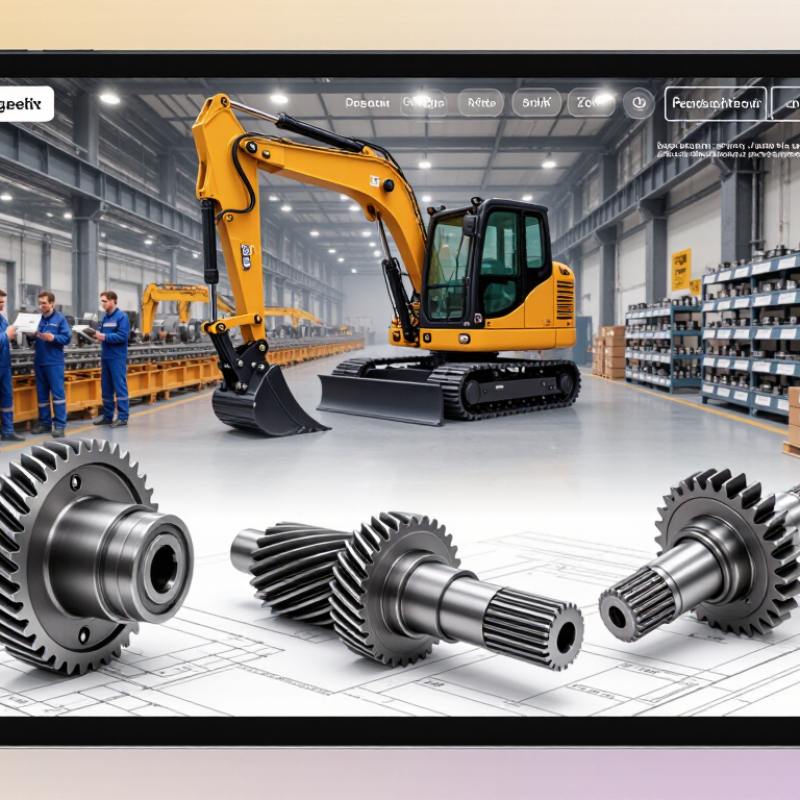
Excavator Gear Basics: Swing, Travel, and Final-Drive Applications
An excavator’s swing gear turns the upper structure, while travel gears drive the tracks. The swing drive handles repeated starts, stops, and sudden resistance as the bucket works. Travel drives face different stresses: rock, mud, slopes, and tight turns. Their final-drive reduction gears multiply motor torque at the sprocket. Small parts, big loads.
Gear selection should reflect duty cycle, not machine size alone. Tooth contact stress, bending strength, lubrication, and bearing support all affect service life. ISO 6336-2:2019 sets out methods for assessing gear surface durability. For bearings inside these assemblies, ISO 281:2007 defines basic rating life at 90% reliability under stated operating conditions. These are calculation references, not guarantees; real contamination and shock loads can shorten life.
Tip: Match supplier data to the actual application. Ask for rated torque, reduction ratio, material and heat-treatment details, sealing design, and test conditions. Check whether the stated load is continuous or intermittent. A clean specification helps, but it can still miss field reality. Record oil condition, noise, and temperature during service checks; changes may reveal wear before a drive fails.
Key Gear Types and Load-Capacity Checks Under ISO 6336
Excavator gear systems use several gear types, each carrying a different share of the work. Swing drives and travel reducers commonly contain planetary gears, while other assemblies may use spur or helical gears. Planetary stages distribute torque across multiple planet gears, but uneven load sharing can raise stress on one tooth set. That detail matters.
For cylindrical gears, ISO 6336 provides methods to assess tooth-root bending strength and flank contact strength. Check both values against the actual duty, not just rated motor torque. An excavator may start under load, turn on uneven ground, or meet sudden resistance. Loads are rarely smooth. Include operating cycles, peak torque, speed, gear dimensions, material properties, and heat-treatment data in the calculation. For bevel gears or complex planetary arrangements, confirm that the selected method fits the geometry and application.
A supplier’s load-capacity review should also examine face width, tooth accuracy, shaft alignment, and lubrication. A narrow contact pattern on a marked tooth can signal misalignment before service begins. Inspect drawings and test records, and verify that stated material and hardness match production parts. A calculation can look convincing and still miss real machine conditions. Revisit assumptions when field duty changes; this step is easy to overlook.
Gear Accuracy Explained: ISO 1328-1 Classes 1–11
For excavator gears, accuracy is more than a drawing note. It affects how teeth meet under load, how smoothly torque transfers, and where wear begins. ISO 1328-1:2013 classifies cylindrical gear flank accuracy from class 1 to class 11. Class 1 has the tightest tolerances; class 11 allows wider deviations. The standard evaluates parameters such as tooth profile, helix, and pitch deviations. Small numbers matter. Yet a class alone does not describe every gear’s performance.
For global buyers, the right class depends on gear geometry, duty cycle, and inspection capability. A swing-drive gear facing repeated load reversals may need tighter control than a lightly loaded component. Ask suppliers for measured inspection results, not only a class on a quotation. ISO 1328-1:2013 provides tolerance limits, but it does not guarantee quiet operation or long service life. Those also depend on material, heat treatment, alignment, lubrication, and assembly. One detail is easy to miss: measurement methods and reporting conditions should be agreed before production. A precise-looking report can still leave room for interpretation. I would compare profile and lead charts against the drawing, then check whether the proposed class is practical for the gear size and application.
Gear Accuracy Explained: ISO 1328-1 Classes 1–11
A quick guide for global excavator gear buyers comparing cylindrical gear accuracy classifications.
ISO 1328-1 class numbers are accuracy designations, not measured deviations: a lower class number indicates tighter accuracy requirements, while a higher number indicates less stringent requirements. The applicable tolerances depend on gear geometry and dimensions, so confirm the required class and inspection criteria for each component.
How to Evaluate Chinese Suppliers: Materials, Heat Treatment, and QC
Excavator gears carry repeated shock loads, so supplier evaluation should begin with the steel grade and its traceability. Ask for the material certificate, heat number, and inspection records, then compare them with the drawing. A certificate alone is not proof. ISO 6336-5:2016 provides gear-material strength data across material quality and heat-treatment conditions, making it a useful reference when reviewing a supplier’s stated design basis.
Heat treatment deserves close attention. For carburized gears, many specifications use a tooth-flank hardness near 58–62 HRC, but the drawing and steel grade must govern. The ASM Handbook, Volume 4A, describes how case depth, core properties, and process conditions affect performance. Request hardness traverse results, effective case-depth measurements, and furnace records—not just a surface reading. Look for distortion checks after quenching; a hard tooth can still be poorly aligned.
Quality control should connect each finished gear to its production batch. Review inspection methods for tooth profile, lead, runout, and surface defects, and ask how rejected parts are handled. ISO 1328-1 defines gear accuracy grades and tolerances, giving buyers a common basis for comparing inspection reports. I would still verify a sample independently. Paperwork can look tidy while a measurement setup is wrong. A small gap remains: supplier audits cannot reveal every process change between visits.
Global Sourcing Checks: Drawings, Lead Times, and Export Requirements
For excavator gears, a clean drawing prevents costly assumptions. Specify tooth count, module, pressure angle, material, hardness, tolerances, and inspection points. Add a marked drawing showing reference surfaces and critical dimensions. Ask suppliers to confirm each detail in writing before production. A small mismatch can stop assembly. It happens.
Lead times need more than a factory estimate. Request separate dates for material sourcing, machining, heat treatment, inspection, and packing. UNCTAD’s Review of Maritime Transport 2024 notes that over 80% of world trade by volume moves by sea, making port schedules and routing relevant to delivery planning. The World Bank’s 2023 Logistics Performance Index also evaluates customs and shipment timeliness. Use these as context, not as a promise of arrival dates. Export documents should match the shipment details; confirm the applicable product classification and documentation with your freight provider.
Tips: Send one controlled drawing revision, request a first-article inspection report, and agree on packaging for heavy parts. Photograph the packed gears and labels before dispatch. Keep a buffer for delays, even when the schedule looks comfortable. That buffer may feel excessive, but ignoring it is often the weaker choice.



 Find Your Solutions ▶