
What Are the 7 Best Centrifugal Flow Fans?

Choosing from the seven best centrifugal fans is not simply a matter of picking the model with the largest airflow rating. A Centrifugal Flow Fan draws air into its center and pushes it outward through a housing, creating a focused stream suited to ducts, equipment, and ventilation systems. Its curved impeller can move air against resistance, but performance depends on the full installation. A tight bend or undersized duct may reduce the airflow you actually feel.

In a workshop, the difference can be clear: one fan clears warm air from a machine enclosure, while another struggles behind a long, narrow duct. Airflow matters. Noise does, too. A strong fan that drones beside a workbench may be a poor everyday choice. This guide compares seven options by practical factors, including airflow, static pressure, sound, power use, build quality, and ease of installation. The right balance depends on the job, not just the product label.

Check the manufacturer’s performance curves and operating limits before comparing headline numbers. Confirm the fan’s voltage, mounting dimensions, and intended environment; these details are easy to overlook. No shortlist can fit every site, and published ratings may not reflect real duct conditions. That limitation deserves attention. The comparisons below offer a useful starting point, not a substitute for measuring your system or getting qualified advice for a demanding installation.
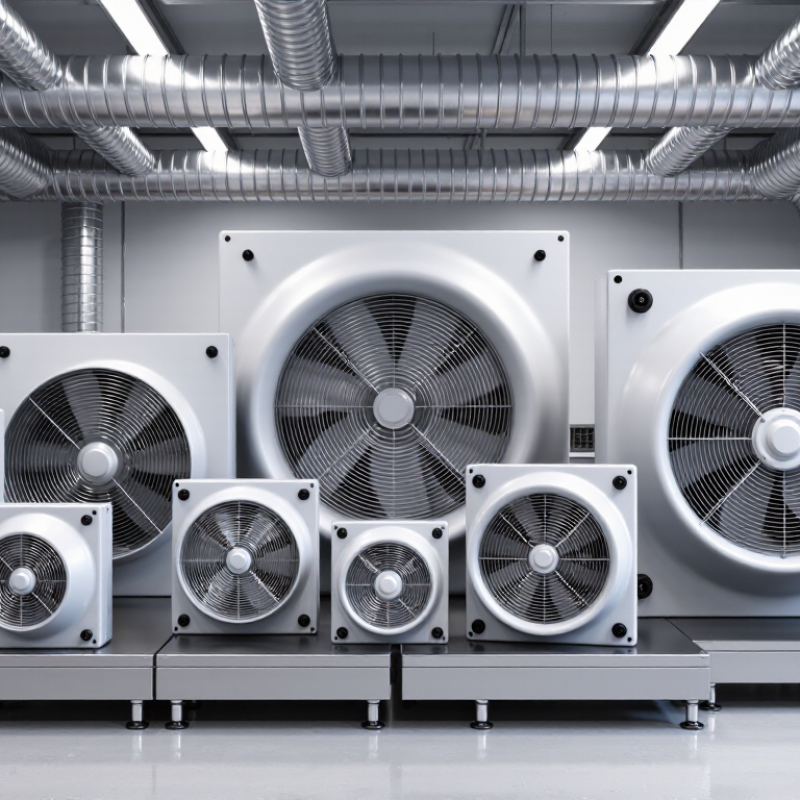
What Are the 7 Best Centrifugal Flow Fans?

What Defines a Centrifugal Flow Fan?

A centrifugal flow fan moves air by drawing it into the center of a rotating impeller and directing it outward. The change in airflow direction distinguishes it from an axial fan, which moves air mostly along the shaft. Curved blades transfer energy to the air, while the fan housing guides it toward the outlet. You can picture air entering at the hub, then leaving through a side opening.

This design can produce useful pressure against resistance from ducts, filters, and bends. That makes centrifugal fans suitable for ventilation systems and equipment cooling. Their performance depends on more than fan size: impeller shape, speed, housing, and system resistance all matter. A powerful-looking fan may still disappoint if it is poorly matched to the ductwork. The terminology can also vary between suppliers, so check the airflow and pressure data rather than relying on a label alone.

Tips: Compare airflow at the pressure your system actually needs. Check noise, power use, and mounting space, too. Keep inlet and outlet paths clear; a sharp bend close to the fan can reduce performance. A small detail, but an easy one to overlook.

How Centrifugal Fans Generate Airflow and Pressure

A centrifugal fan moves air by spinning an impeller. Its blades accelerate air outward, from the eye toward the housing. The curved casing gathers that flow and guides it toward the outlet. As air slows in the casing, some of its velocity energy becomes static pressure. Not magic. The fan’s delivered airflow depends on the resistance of the connected ducts, filters, and dampers.

The U.S. Department of Energy’s Improving Fan System Performance sourcebook describes the operating point as the intersection of a fan curve and a system-resistance curve. A clogged filter can shift that point, reducing airflow even while the motor keeps running. AMCA Publication 201-02, Fans and Systems, presents the fan laws: at constant diameter, airflow changes with rotational speed, pressure with speed squared, and power with speed cubed. For example, a 10% speed increase can mean roughly 21% more pressure and 33% more power under comparable conditions. These are useful estimates, not guarantees; real installations have losses. Measure airflow and pressure at the system, rather than choosing by wheel shape alone. A small detail matters: a tight bend near the outlet can disturb flow and undermine a seemingly sound selection.

What Are the 7 Best Centrifugal Flow Fans? - How Centrifugal Fans Generate Airflow and Pressure

Fan Type or Configuration How It Generates Airflow and Pressure Best Suited For Key Advantages Important Considerations
Backward-curved centrifugal fan Backward-leaning blades accelerate air outward from the impeller and are designed for efficient operation across a range of system pressures. General HVAC systems, air-handling units, and clean-air ventilation. Typically offers good efficiency and a non-overloading power characteristic in its intended operating range. Choose the fan from its performance curve; efficiency and motor power depend on the operating point and system design.
Airfoil centrifugal fan Airfoil-shaped backward-curved blades reduce aerodynamic losses as the impeller moves air from the inlet toward the outlet. Large HVAC systems and applications that prioritize efficient movement of clean air. Can provide high efficiency and relatively quiet operation when correctly selected and installed. Airfoil blades are generally intended for clean air; dust or material buildup can reduce performance and require cleaning.
Backward-inclined centrifugal fan Flat or slightly curved blades lean away from the direction of rotation, producing a backward-curved airflow pattern. Ventilation and process-air systems handling relatively clean air. Often combines efficient operation with a comparatively stable power characteristic. It is not a substitute for a material-handling design where the airstream contains heavy or abrasive particles.
Forward-curved centrifugal fan Many small, forward-facing blades move air into a scroll-shaped housing, making the design suitable for high airflow at relatively low pressure. Compact HVAC equipment, fan-coil units, and low-pressure ventilation systems. Compact construction can deliver substantial airflow from a relatively small wheel. Efficiency is often lower than that of well-selected backward-curved designs, and motor load must be checked against the fan curve.
Radial-blade centrifugal fan Straight blades extend outward from the hub and move air radially, providing a robust wheel design for demanding airstreams. Dust collection, conveying, and systems handling particles or process materials. Typically rugged and less prone to material buildup than designs with narrow, curved blade passages. May be noisier or less efficient than aerodynamic blade designs in clean-air service; abrasion and particle size still matter.
Radial-tip centrifugal fan Radial blades with backward-curved outer tips combine a robust central blade form with an aerodynamic discharge region. Some industrial exhaust and material-laden air applications where a balance of durability and efficiency is needed. Can handle certain particle-bearing airstreams while offering improved aerodynamic performance over a basic radial wheel. Suitability depends on particle characteristics, concentration, erosion risk, and the manufacturer’s performance data.
Inline centrifugal fan A centrifugal impeller is installed in a duct-mounted housing; the fan changes the airflow direction internally while keeping the inlet and outlet aligned with the duct. Ducted ventilation where installation space or a straight-through duct layout is important. Can be installed within a duct run and may simplify layouts compared with a conventional side-discharge arrangement. “Inline” describes the housing arrangement, not one specific blade design; pressure, sound, and efficiency vary by model.

How centrifugal fans work: Air enters near the impeller’s center, gains energy as the rotating blades accelerate it outward, and leaves through the fan housing or outlet. The fan’s delivered airflow and pressure depend on its design, speed, and the resistance of the connected system. Inline describes a fan arrangement, while the other entries primarily describe impeller designs.

Which Features Matter When Comparing Centrifugal Fans?

When comparing the seven best centrifugal flow fans, start with the operating point, not the largest airflow figure. A fan must deliver the required volume against the system’s resistance. Check its performance curve at your expected duct pressure. Check the curve. A unit that looks powerful on paper may struggle once filters, bends, and grilles are installed.

Efficiency matters over real operating hours. Compare power draw at the duty point, and consider whether speed control can match changing demand. Listen for noise at the intended speed; a quiet rating measured under different conditions may not reflect a small office or workshop. Noise matters. Construction also deserves a close look. Inspect the impeller, housing, and corrosion protection for the air’s temperature, moisture, and dust level. Then check access for cleaning, bearing service, and safe mounting. A compact fan can be awkward to maintain above a ceiling. That detail is easy to miss. Ask for test conditions and installation limits, and compare like with like. If specifications leave gaps, treat the choice as uncertain rather than assuming the highest number means the best fit.

What Are the 7 Best Centrifugal Flow Fans?

Which Features Matter When Comparing Centrifugal Fans?

Fan selection depends on the required airflow, pressure, efficiency, noise level, and operating conditions—not on a universal ranking. The chart below shows how airflow, pressure, and power change with fan speed under the fan affinity laws, assuming constant impeller diameter and air density.

How to read it: Relative airflow varies with speed, pressure with speed squared, and power with speed cubed. Use these relationships as estimates; compare real fan curves at the required duty point before choosing a fan.

Seven Centrifugal Fan Designs and Their Best Applications

Centrifugal fans move air by drawing it into the impeller and directing it outward. Their blade shape and housing determine how they handle pressure, dust, and changing airflow. The best choice depends on the job, not just the fan’s size.

Forward-curved fans suit low-pressure ventilation in compact air handlers, where many narrow blades move air quietly at modest speeds. Backward-inclined fans work well in general ventilation systems that need steady airflow and reasonable efficiency. Backward-curved fans handle higher pressures, while airfoil-blade versions are especially useful for clean-air systems that run for long hours. Keep them clean. Dust buildup can reduce performance.

Radial-blade fans are a practical choice for dusty or abrasive air, such as workshop exhaust, because their sturdy blades tolerate rough service. Radial-tip designs combine useful pressure with better resistance to material buildup, making them suitable for some industrial exhaust streams. Paddle-wheel fans handle fibrous or bulky particles, though their open construction may not fit every process. Tubular centrifugal fans place a centrifugal wheel inside a cylindrical casing, making them useful in ducted ventilation where space is tight. I would not call any design universally best. Check the actual airflow, pressure, particle load, and maintenance access; these details are easy to underestimate.

How to Select a Fan for Your Operating Requirements

The best centrifugal flow fan is not automatically the largest or most powerful model. It is the one that delivers the required airflow at the system’s actual resistance. Start with the operating point: airflow, static pressure, air temperature, and hours of use. Then check what the air carries. Fine dust, moisture, or corrosive vapors can change material and impeller choices. Small details matter.

Seven common options suit different duties: backward-curved and airfoil fans often serve clean-air systems; forward-curved designs fit compact, lower-pressure applications; radial-blade wheels handle dustier streams; inline centrifugal units save installation space; high-pressure designs serve demanding ductwork; and corrosion-resistant constructions suit chemically aggressive environments. These are starting points, not guarantees. A fan’s performance can shift when elbows, filters, dampers, or long ducts add resistance.

Compare fan curves at your expected operating point, rather than choosing by motor power alone. Check efficiency, noise, speed control, maintenance access, and motor temperature limits. Ask for certified performance data and confirm whether it reflects the installed configuration. Measure the system after startup; real duct losses can differ from estimates. That assumption can fail. A short field test may reveal a poor match before it becomes an expensive operating habit.

Certified Quality System

© North Easton Machine Company, Inc. All rights reserved. • Site: Blog
NORTH EASTON MACHINE • 218 Elm Street • North Easton, MA 02356 • 508-238-6219