
How to Choose the Right Carbon Graphite Rods?

Choosing the right Carbon Graphite Rods begins with understanding the working environment, not the product photograph. Temperature, electrical load, chemical exposure, mechanical stress, and machining requirements all influence performance. A rod used in a dry furnace may fail quickly in an oxidizing atmosphere. That difference matters.

The U.S. Geological Survey’s Mineral Commodity Summaries 2024 estimated global natural graphite mine production at approximately 1.6 million metric tons in 2023. China supplied most of that output, highlighting the importance of consistent sourcing and material traceability. Meanwhile, the International Energy Agency’s Global Critical Minerals Outlook 2024 reported strong graphite demand growth from clean-energy technologies. These figures do not directly define rod quality, but they reveal a tightening and increasingly strategic supply chain.

Technical selection should compare apparent density, electrical resistivity, flexural strength, grain size, porosity, and dimensional tolerance. ASTM test methods, including ASTM C559 for density and ASTM C611 for resistivity, can support reliable supplier comparisons. Ask for batch-specific certificates, not only a general datasheet. Request the grade, purity, machining tolerance, and recommended operating atmosphere in writing. Small pores can become crack sites. Poorly machined ends can create uneven current flow. No single grade wins everywhere. That assumption deserves review. Experience also shows that the cheapest rod can become expensive after premature replacement, unstable heating, or difficult installation. A careful choice connects test data with the actual furnace, electrical circuit, and maintenance routine.
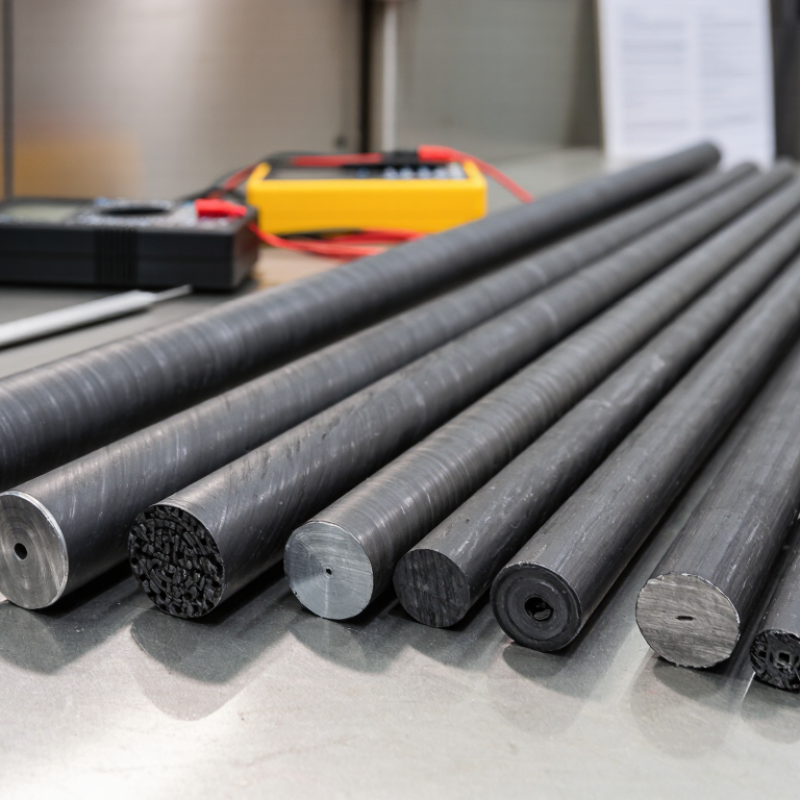
How to Choose the Right Carbon Graphite Rods?

Carbon Graphite Rod Basics: Types, Properties, and Common Uses

How to Choose the Right Carbon Graphite Rods?

Carbon graphite rods differ in structure, purity, and manufacturing method. Extruded rods suit general furnace fixtures and electrical contacts. Molded grades offer consistent dimensions and useful mechanical strength. Isostatic graphite provides finer grain, lower porosity, and better thermal uniformity. Check density, ash content, electrical resistivity, and maximum working temperature before ordering. Graphite conducts heat efficiently, resists thermal shock, and machines cleanly. However, it oxidizes quickly in hot air. Use vacuum or an inert atmosphere when temperatures rise significantly.

The U.S. Geological Survey reported approximately 1.6 million metric tons of natural graphite mine production in 2023. Its 2024 Mineral Commodity Summaries also identified graphite as a strategically important material. The International Energy Agency reported that graphite processing remains highly concentrated globally. These figures describe the broader supply chain, not rod quality. Still, they show why traceable material certificates matter. Common applications include furnace supports, electrochemical electrodes, laboratory components, and high-temperature tooling. A rod that looks smooth may still contain hidden pores. That detail can change performance.

Tips: Match rod diameter to current load and bending stress. Ask for purity data, grain size, density, and test conditions. Measure actual dimensions before installation. In my experience, selecting only by temperature rating is a weak shortcut. Atmosphere, contact pressure, and repeated heating often matter more. Leave a safety margin.

Define Your Application Requirements and Operating Conditions

How to Choose the Right Carbon Graphite Rods?

Define Your Application Requirements and Operating Conditions

Choosing carbon graphite rods starts with the job, not the material catalog. Describe what the rod must do. Will it carry electrical current, transfer heat, support a load, or contact molten material? Each function requires different properties. Electrical heating demands stable resistance and accurate dimensions. A mechanical support needs strength, stiffness, and resistance to vibration.

Record the operating conditions in measurable terms. Note the working temperature, heating rate, atmosphere, voltage, current, pressure, and exposure time. Air, vacuum, inert gas, and reactive gases can affect oxidation and service life differently. Measure the available space carefully. A rod that is only slightly oversized may create installation stress. Small details matter.

Consider grade, purity, density, grain structure, and machining tolerance. Fine-grain graphite often suits applications requiring smooth surfaces and precise shapes. Higher density may improve durability, but it can change thermal response. Check the manufacturer’s technical data, especially maximum operating limits and thermal expansion values. Do not rely on a generic “high-temperature” claim.

In practical selection work, I compare expected loads with real operating cycles, not ideal laboratory conditions. A calculation can still miss uneven heating or repeated start-ups. I have also seen dimensions copied incorrectly between drawings. That mistake is simple, yet expensive. Confirm the rod diameter, length, connection method, and inspection requirements before production. Keep a record of test results from the first operating cycle.

Compare Rod Grades, Dimensions, and Performance Characteristics

How to Choose the Right Carbon Graphite Rods?

Rod selection starts with grade, not appearance. Fine-grain graphite usually offers smoother machining and better surface detail. Medium-grain grades may reduce cost, but their rougher structure can increase edge chipping. Isostatic graphite often provides more uniform properties across the rod. According to ASTM C838, apparent density and open porosity are important indicators when comparing graphite materials. Typical industrial grades range from about 1.70 to 1.90 g/cm³ in density, although specifications differ.

Dimensions directly affect performance. A long, thin rod can deflect during machining or heating. A larger diameter improves stiffness but may slow thermal response. Check diameter tolerance, straightness, usable length, and end squareness before ordering. Measure twice. In practical handling, even a small surface crack can spread during thermal cycling. I have found that cutting allowance is often underestimated, especially when drilling or threading graphite rods. That mistake wastes material.

Electrical resistivity and thermal conductivity should match the application. Lower resistivity supports heating and electrical contact uses. Uniform grain structure usually improves predictable current flow and thermal expansion behavior. The USGS Mineral Commodity Summaries 2024 reported approximately 1.6 million metric tons of worldwide natural graphite mine production in 2023, reflecting graphite’s broad industrial importance. However, volume data does not guarantee rod quality. Request a certificate showing density, ash content, resistivity, grain size, and test methods. Supplier claims can be incomplete. Independent verification remains worthwhile.

How to Choose the Right Carbon Graphite Rods?

Compare representative graphite grades by flexural strength and electrical resistivity. Fine-grain and high-purity grades generally provide better mechanical consistency and lower electrical resistance, while coarse-grain grades are often selected for less demanding applications and cost-sensitive designs.

Fine-Grain Graphite
Typical density: 1.70–1.80 g/cm³
Typical flexural strength: 40–70 MPa
Suitable for precision machining and electrical components.
Medium-Grain Graphite
Typical density: 1.65–1.80 g/cm³
Typical flexural strength: 30–55 MPa
A balanced option for general thermal and mechanical use.
Coarse-Grain Graphite
Typical density: 1.60–1.75 g/cm³
Typical flexural strength: 20–40 MPa
Commonly used where thermal shock resistance and economy are important.
High-Purity Graphite
Typical purity: above 99.9% carbon
Typical rod diameters: 6–50 mm
Common cut lengths: approximately 100–1,000 mm.

The chart uses representative mid-range values for commercially manufactured graphite grades. Actual properties vary with grain size, forming method, heat treatment, purity, porosity, and supplier specifications. Always confirm the material datasheet before final selection.

Evaluate Purity, Machining Quality, and Supplier Standards

How to Choose the Right Carbon Graphite Rods?

Evaluate Purity, Machining Quality, and Supplier Standards

Purity and Traceable Sourcing

Purity should match the operating environment, not only the product label. Ask for ash content, bulk density, electrical resistivity, and trace-element results. The USGS Mineral Commodity Summaries 2024 reported about 1.6 million metric tons of natural graphite production in 2023. China supplied roughly 77% of that volume. This concentration makes traceable sourcing especially important. A glossy rod can still contain unwanted mineral residue.

Machining Quality and Inspection

Machining quality affects fit, heat transfer, and service life. Check diameter tolerance, straightness, surface roughness, and edge condition on the inspection sheet. Measure several points, not only the middle. ISO 9001 certification shows controlled processes, but it does not guarantee perfect graphite rods. Request batch-level certificates and test methods, such as ASTM-based density or ash testing. In practice, small chips around drilled holes often reveal weak handling controls. No inspection is perfect. That deserves honest attention.

Tips: Request a sample before bulk purchasing. Compare certificates with independent test results. Ask how suppliers control dust, packaging, and dimensional changes after machining. Review their corrective-action records, not just their certificates. A supplier who explains one failed batch may be more reliable than one offering flawless claims.

Select the Right Rod and Verify Its Suitability Before Purchase

How to Choose the Right Carbon Graphite Rods?

Select the Right Rod and Verify Its Suitability Before Purchase

Choosing a carbon graphite rod starts with the operating environment, not the lowest quotation. Consider temperature, electrical load, chemical exposure, machining needs, and required service life. High-purity graphite may suit furnace parts, electrodes, and laboratory fixtures, while denser grades often resist wear and mechanical damage better. Check diameter, length, straightness, surface condition, grain size, bulk density, electrical resistivity, and ash content. Small differences matter.

Verify the data before purchasing. The U.S. Geological Survey reported global natural graphite mine production of about 1.6 million metric tons in 2023, showing the scale of a complex and variable supply chain. The International Energy Agency also identifies graphite as a critical mineral for expanding battery and industrial applications. These figures do not prove that every rod is consistent. They make traceability more important.

Ask for a certificate of analysis, applicable test methods, batch number, and dimensional tolerances. Request a sample when the rod will face thermal cycling or continuous current. Measure its diameter with a calibrated micrometer, inspect both ends for cracks, and compare the delivered density with the specification. A datasheet can still be incomplete. I would not approve a rod based on purity alone. The wrong grain structure may machine poorly, fracture during heating, or create unstable electrical resistance. Test a small batch under realistic conditions, then record the results for future purchasing decisions.

How to Choose the Right Carbon Graphite Rods? - Select the Right Rod and Verify Its Suitability Before Purchase

Selection Dimension Typical Data or Available Range Why It Matters How to Verify Before Purchase
Rod Diameter Common stock sizes: approximately 3–100 mm; custom sizes may be available. Diameter affects mechanical strength, electrical capacity, heat distribution, and fit within the assembly. Measure the required bore, clearance, and active length. Confirm diameter tolerance on the technical drawing.
Rod Length Standard lengths commonly range from about 50–1,000 mm, depending on diameter and manufacturing method. Longer rods can deflect or break more easily and may require additional supports. Specify usable length, total length, end geometry, and support spacing. Check straightness requirements.
Graphite Grade Fine-grain, medium-grain, and coarse-grain grades are commonly offered. Fine-grain graphite generally provides a smoother surface and better dimensional detail; coarse grades may be more economical for less demanding uses. Request grain size, manufacturing process, porosity, and recommended application limits.
Bulk Density Typical industrial graphite grades: approximately 1.65–1.90 g/cm³. Higher density often indicates lower open porosity and improved resistance to penetration by gases or molten materials. Compare the certified bulk-density value with the required grade specification; do not judge density by appearance alone.
Apparent Porosity Many dense industrial grades fall within approximately 8–20%, although values vary by grade and process. Lower porosity can improve resistance to oxidation, infiltration, and mechanical damage in demanding environments. Ask for the test method and certified porosity value. Match it to the operating atmosphere and fluid-contact conditions.
Electrical Resistivity Typical values are roughly 5–15 μΩ·m at room temperature, depending on grade and orientation. Resistivity determines voltage drop, current distribution, and heat generation when the rod is used as an electrical conductor or heating element. Request the test temperature, measurement direction, and tolerance. Calculate resistance using R = ρL/A.
Thermal Conductivity Approximately 50–200 W/m·K for many industrial grades at room temperature; the actual value depends strongly on grade and direction. High conductivity spreads heat quickly and helps reduce local temperature gradients. Confirm whether the value is parallel or perpendicular to the grain or extrusion direction, and check the test temperature.
Maximum Service Temperature Inert or vacuum environments may permit use near 2,500–3,000°C; oxidation begins at much lower temperatures in air. Graphite can oxidize rapidly in oxygen-containing atmospheres, so the atmosphere is as important as the nominal temperature rating. Specify gas composition, oxygen level, pressure, heating rate, and exposure time. Do not use an inert-atmosphere rating for open-air service.
Mechanical Strength Room-temperature flexural strength commonly ranges from approximately 20–80 MPa; compressive strength is often about 60–150 MPa. Graphite is strong in compression but brittle and relatively weak in tension, bending, and impact loading. Calculate bending stress, provide adequate support, and request flexural strength and elastic-modulus data at the intended temperature.
Thermal Expansion A typical linear coefficient is approximately 2–8 × 10⁻⁶/K, depending on grade and direction. Low expansion helps with thermal cycling, but differences between graphite and surrounding materials can create stress. Check the expansion coefficient over the complete temperature range and allow appropriate installation clearance.
Purity and Ash Content Industrial grades may range from approximately 99.0% to 99.999% carbon; ash limits vary by application. Impurities can affect electrical behavior, corrosion resistance, contamination control, and high-temperature performance. Request a certificate of analysis stating carbon purity, ash content, impurity limits, and the testing method.
Surface Finish Machined surfaces may be specified from visibly rough finishes to fine finishes around Ra 0.8–3.2 μm, depending on the process. Surface condition affects sealing, electrical contact, friction, contamination, and dimensional fit. Define the required roughness, chamfer, edge condition, and allowable chips or cracks on the drawing.
Chemical Compatibility Graphite is generally compatible with many molten metals and chemicals, but it can react with oxygen and some carbide-forming materials. Reaction, wetting, infiltration, or contamination may shorten service life or affect product quality. Test a sample with the actual material, temperature, atmosphere, and contact duration before approving full production quantities.
Dimensional Tolerance Typical tolerances may range from about ±0.1 mm for precision-machined small parts to ±1 mm or more for larger rough-cut rods. Oversized or undersized rods may cause assembly problems, uneven heating, or premature failure. Obtain a controlled technical drawing and inspect diameter, length, straightness, concentricity, and end features upon delivery.
Recommended Pre-Purchase Validation Sample inspection, dimensional measurement, electrical testing, thermal trial, and atmosphere-compatibility evaluation. A datasheet alone may not reflect the effect of actual load, mounting, atmosphere, or thermal cycling. Approve the rod only after comparing test results with the application requirements and acceptance criteria.

Note: The values shown are typical industry ranges for carbon graphite and are provided for preliminary selection only. Actual properties vary by grade, forming method, grain orientation, test method, and operating environment.

Certified Quality System

© North Easton Machine Company, Inc. All rights reserved. • Site: Blog
NORTH EASTON MACHINE • 218 Elm Street • North Easton, MA 02356 • 508-238-6219