
How to Choose a 35kV Power Transformer Supplier?
Choosing a 35kv Power Transformer supplier is a practical decision, not a simple price comparison. The supplier’s factory, testing discipline, and field support deserve close attention. A strong supplier should provide traceable materials, clear technical drawings, routine test reports, and documented quality procedures. Ask to see evidence, not promises.
James H. Harlow, a recognized electrical engineering author, describes a transformer as “a static device that transfers electrical energy from one circuit to another.” That simple definition hides serious engineering demands. At 35kV, insulation coordination, impulse withstand, cooling performance, and partial discharge control become critical. A reliable supplier should explain these factors in plain language. They should also connect them with your load profile, installation altitude, ambient temperature, and protection scheme.
Look beyond the quotation. Visit the manufacturing facility if possible. Observe winding cleanliness, oil handling, drying equipment, and final inspection practices. Request references from utilities or industrial plants using similar units. Check whether the supplier supports commissioning, oil testing, warranty claims, and spare parts after delivery. These details often reveal operational experience.
However, no checklist is perfect. A polished factory can still offer weak communication. A low-cost quotation can become expensive during installation. I have seen specifications that looked complete but missed transport limits and site access conditions. That mistake is easy to overlook. Your evaluation should therefore combine technical records, supplier experience, independent verification, and direct conversations with engineers. The best 35kv Power Transformer supplier is not always the largest one. It is the one that can prove reliability before energization.
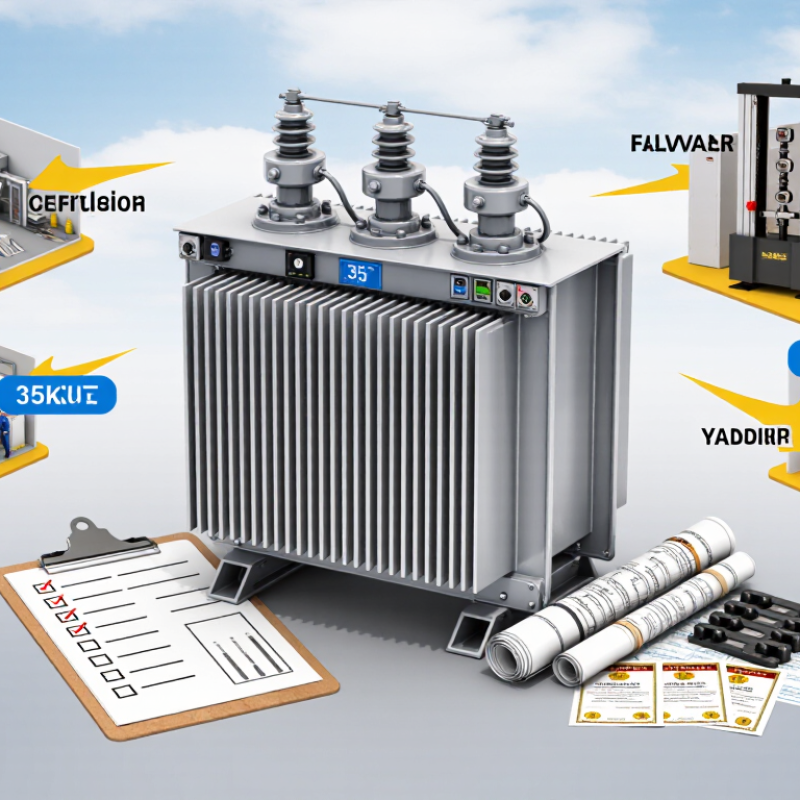
Define the Technical Requirements for a 35kV Power Transformer
How to Choose a 35kV Power Transformer Supplier?
Define the Technical Requirements for a 35kV Power Transformer
Begin with the actual network conditions, not a supplier’s standard catalog. Specify rated power in MVA, primary and secondary voltages, frequency, phase arrangement, vector group, impedance, and tap range. For a 35kV system, confirm the highest equipment voltage, often 36kV, and the required lightning impulse withstand level. IEC 60076-3 commonly guides insulation coordination, while IEC 60076-5 addresses short-circuit withstand capability.
Site conditions matter just as much. Record ambient temperature, altitude, humidity, pollution level, seismic exposure, indoor or outdoor installation, and available space. Select ONAN or ONAF cooling according to the load profile. Include oil type, enclosure protection, noise limits, bushings, surge arresters, temperature indicators, and online monitoring. A transformer designed for 40°C ambient air may perform differently at a 2,000-meter site.
Losses deserve careful attention. The U.S. Department of Energy has estimated that distribution transformer losses consume more than 60 billion kWh annually in the United States. Therefore, request guaranteed no-load and load-loss values, measured under defined conditions. Ask for routine and type-test records, including ratio, winding resistance, insulation, induced-voltage, and partial-discharge tests. IEC 60076-1 supports these verification requirements.
Do not assume a familiar vector group fits every grid. That assumption can be wrong. Request a thermal calculation, short-circuit design evidence, delivery inspection plan, spare-parts list, and service response terms. A technically strong supplier should explain each figure clearly, not merely reproduce a template.
| Technical Dimension | Recommended Requirement or Typical Specification | What the Buyer Should Confirm | Supplier Evidence to Request |
|---|---|---|---|
| Applicable Standards | IEC 60076 series or the applicable national equivalent; IEC 60296 for mineral insulating oil when relevant. | The quotation, design drawings, routine tests, type tests, and acceptance tests should use the same edition and standard basis. | Standards compliance statement, technical deviation list, and sample test reports. |
| Transformer Type | Three-phase, oil-immersed distribution or power transformer; hermetically sealed or conservator type according to the project environment. | Confirm whether the installation requires an indoor, outdoor, compact-substation, or conventional outdoor design. | General arrangement drawing, cross-sectional drawing, and installation requirements. |
| Rated Power | Project-specific, commonly selected from standard ratings such as 1,600 kVA, 2,000 kVA, 2,500 kVA, 5,000 kVA, or higher. | The rating should cover the calculated maximum demand, motor starting conditions, harmonic loads, ambient temperature, and planned load growth. | Load study, temperature-rise calculation, overload capability statement, and rating plate data. |
| High-Voltage Rating | 35 kV nominal system voltage; the equipment highest voltage is commonly 40.5 kV for this voltage class. | Check the utility voltage, operating range, system earthing method, and required insulation coordination. | Rated-voltage schedule, insulation-coordination study, and winding design data. |
| Low-Voltage Rating | Selected for the downstream network, commonly 10.5 kV, 6.3 kV, 3.3 kV, 0.4 kV, or another project-defined value. | Confirm the required secondary voltage at no load and full load, including allowable voltage drop. | Single-line diagram, voltage regulation calculation, and terminal arrangement drawing. |
| Frequency | 50 Hz or 60 Hz, matching the power system. | A transformer designed for one frequency should not be applied to another frequency without confirming flux density and thermal performance. | Guaranteed technical particulars and magnetic-circuit design confirmation. |
| Insulation Level | For a 40.5 kV highest-voltage class, a commonly specified level is 95 kV power-frequency withstand and 200 kV lightning-impulse withstand, subject to the governing standard and system study. | The required withstand levels must coordinate with surge arresters, cable insulation, switching conditions, and site altitude. | Insulation-level schedule, impulse-test report, and insulation-coordination documentation. |
| Connection and Vector Group | Common arrangements include Dyn11 for a grounded low-voltage neutral; other groups may be required by the network. | Confirm phase displacement, neutral availability, zero-sequence behavior, parallel-operation compatibility, and earthing requirements. | Vector-group diagram, winding connection diagram, and phase-displacement test result. |
| Tap-Changing Method | Off-circuit tap changer commonly ±2 × 2.5% or ±5%; on-load tap changer is used where voltage must be regulated while energized. | Define the tap range, tap step, control voltage, operating sequence, interlocks, and whether automatic voltage regulation is required. | Tap-changer datasheet, wiring diagram, control schematic, and operation test procedure. |
| Cooling Method | ONAN for natural oil and air cooling; ONAF may be specified for higher ratings or compact installations requiring additional capacity. | Confirm fan redundancy, automatic starting temperatures, auxiliary power supply, noise impact, and emergency cooling capability. | Cooling-system calculation, fan control logic, auxiliary-load schedule, and alarm list. |
| Insulating Medium | Mineral insulating oil meeting the specified standard; ester fluid may be selected for improved fire safety or environmental requirements. | Check fire point, biodegradability, compatibility with materials, low-temperature performance, and oil-filling requirements. | Oil certificate, material-compatibility statement, factory filling procedure, and safety data sheet. |
| Impedance Voltage | Often approximately 6%–10% for medium-voltage power transformers, but the exact value must be calculated for the network. | The impedance affects fault current, voltage regulation, motor starting, and parallel operation. It must match the protection study. | Guaranteed impedance tolerance, short-circuit calculation, and parallel-operation requirements. |
| Load Loss and No-Load Loss | Guaranteed maximum values should be defined at the specified reference temperature and rated tap, rather than using a generic efficiency claim. | Evaluate total ownership cost using the expected load profile, energy tariff, operating hours, and capitalization factors. | Loss guarantee, loss-calculation sheet, routine-test result, and correction method for test temperature. |
| Temperature Rise | Common IEC-based designs use approximately 60 K oil top-rise and 65 K winding average-rise, subject to the specified insulation system and standard. | Adjust the design for ambient temperature, altitude, enclosure conditions, cooling method, and continuous loading. | Thermal calculation, temperature-rise test report, and permissible ambient-condition statement. |
| Ambient Conditions | Define maximum and minimum air temperature, daily average, annual average, solar radiation, humidity, pollution, seismic conditions, and altitude. | Altitude above the standard reference level may require derating or special insulation and cooling consideration. | Site-condition compliance matrix and derating calculation where applicable. |
| Short-Circuit Withstand | The transformer should withstand the calculated thermal and mechanical short-circuit stresses for the specified fault duration. | Use the actual network fault level, clearing time, neutral arrangement, and protection settings rather than a generic statement. | Short-circuit withstand calculation, design verification report, and protection coordination data. |
| Partial Discharge | Specify the maximum acceptable partial-discharge level and measurement method in accordance with the selected standard and project requirements. | The requirement is especially important for high-voltage insulation quality, cable terminations, and long-term reliability. | Partial-discharge test procedure, calibrated measurement records, and acceptance criteria. |
| Bushing and Cable Interface | Select porcelain or composite bushings and define cable-box, separable-connector, or busbar interfaces according to the installation. | Confirm creepage distance, pollution level, terminal arrangement, cable size, phase spacing, and access for maintenance. | Bushing datasheets, terminal drawings, creepage calculation, and cable-connection details. |
| Protection and Monitoring | Typical accessories include oil-temperature indication, winding-temperature indication, pressure relief device, oil level indicator, and Buchholz relay for conservator designs. | Define alarm, trip, remote indication, SCADA contacts, sensor accuracy, and fail-safe behavior. | Instrument list, alarm-and-trip matrix, terminal plan, and communication interface schedule. |
| Noise Level | Specify the guaranteed sound-pressure or sound-power level using the selected measurement standard and measurement distance. | Consider nearby residences, offices, hospitals, substations, and night-time operating limits. | Noise guarantee, measurement method, factory test record, and acoustic mitigation proposal if needed. |
| Fire and Environmental Requirements | Provide bunding or oil containment where required; consider low-flammability ester fluid for locations with strict fire-risk controls. | Confirm local fire code, spill containment volume, drainage, ecological restrictions, and fluid disposal requirements. | Fire-safety assessment, fluid certificate, containment drawing, and environmental compliance statement. |
| Factory Testing | Routine tests should include winding resistance, ratio and phase displacement, impedance and load loss, no-load loss and current, dielectric tests, and leak or pressure checks as applicable. | Define witness points, independent inspection, sampling rules, calibrated equipment, and acceptance criteria before production. | Inspection and test plan, quality certificate, calibration records, and complete certified test reports. |
| Type and Special Tests | Depending on the project, request evidence for temperature rise, lightning impulse, short-circuit withstand, sound level, partial discharge, and climatic or seismic performance. | Confirm whether existing test evidence is technically representative of the offered rating, voltage class, design, and accessories. | Accredited laboratory reports, design-comparison statement, and test-validity declaration. |
| Documentation and Support | Require approved drawings, manuals, spare-parts list, commissioning instructions, maintenance intervals, and warranty terms. | The supplier should define delivery scope, exclusions, installation supervision, training, response time, and replacement-part availability. | Document register, project schedule, warranty statement, service plan, and recommended spare-parts schedule. |

Certified Quality System

 Find Your Solutions ▶
NORTH EASTON MACHINE • 218 Elm Street • North Easton, MA 02356 • 508-238-6219