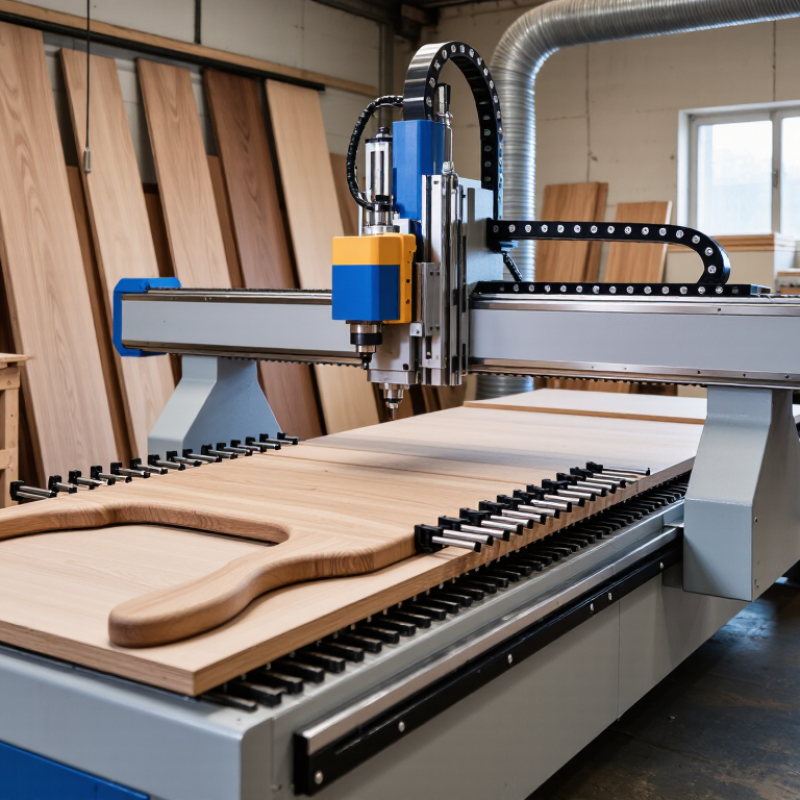
How to Choose a 5 Axis Wood CNC Machine?

Choosing a 5 Axis Wood Cnc Machine is a practical decision, not a race for the most impressive specifications. The right machine must match your materials, workshop space, software skills, and production goals. A sculptor cutting curved chair legs needs different capabilities from a cabinetmaker producing repeated panels.

John Dammeyer, a respected CNC educator and author, has often stressed this principle: “The machine is only one part of the CNC system.” That observation remains important. A powerful spindle cannot correct weak fixturing, poor toolpaths, or inaccurate calibration. It is also worth admitting that buyers sometimes focus too heavily on axis numbers. More movement does not automatically mean better furniture.

This guide examines the details that affect daily results. We will compare the rotary range, work envelope, spindle power, controller reliability, and machine rigidity. Dust extraction matters too. Fine walnut dust can settle around rails, sensors, and cooling vents within hours. Check the table design, vacuum compatibility, and access to replacement parts before ordering. A local technician may save more production time than an extra kilowatt.

Look closely at sample cuts, not only glossy videos. Ask whether the machine can hold accuracy across thick oak, plywood, and irregular blanks. Review training support and software compatibility. These details reveal practical experience.

Some recommendations will remain conditional. No single 5 Axis Wood Cnc Machine suits every workshop. Your first choice may still need adjustment after real production begins. That is normal. Careful testing usually beats confident guessing.

How to Choose a 5 Axis Wood CNC Machine?

Define the Woodworking Tasks the Machine Must Perform

How to Choose a 5 Axis Wood CNC Machine?

Define the Woodworking Tasks the Machine Must Perform

Start with the workpiece, not the axis count. List every operation: sculpting chair legs, cutting stair parts, drilling angled holes, or carving relief panels. A five-axis machine helps when the tool must approach several surfaces without repeated repositioning. It may add little value for flat signs or simple cabinet panels.

The USDA Forest Products Laboratory’s Wood Handbook identifies grain direction, density, and moisture content as major machining variables. These details affect cutting quality and tool wear. Record your common wood species, maximum dimensions, smallest radii, and required tolerance. Then test whether the machine’s spindle, rotary table, clearance, and workholding system can support them. Tight corners need suitable tooling, not only more axes.

Market growth can mislead buyers. Grand View Research estimated the global CNC machine market at about USD 86.7 billion in 2023, with continued expansion ahead. That figure describes demand, not your workshop’s actual needs. I still see users over-specify the fifth axis. That choice can be wrong. Complex sculptures may require simultaneous five-axis motion, while furniture components may need only indexed positioning. Check the CAM software, post-processor, dust extraction, and operator training before approving the machine. A beautiful demo cut is not enough. Run your own wood, grain direction, tooling, and finishing schedule through a sample test.

Compare 5-Axis Configurations, Motion Ranges, and Cutting Access

How to Choose a 5 Axis Wood CNC Machine?

A 5-axis wood CNC machine should be judged by cutting access, not axis count alone. A 2024 MarketsandMarkets report estimates the global CNC machine market will grow strongly through 2029, but market growth does not guarantee suitable woodworking performance. Compare the machine’s kinematic layout: swivel-head, rotary-table, or combined configurations. A swivel-head design usually handles tall cabinets and deep reliefs better. A rotary table can improve stability on smaller, heavier workpieces. Combined systems offer broader access, but they often increase setup complexity and collision risks.

Motion range matters more than brochure language. Check X, Y, and Z travel against your largest panel, then allow space for clamps and tool holders. Review A-axis and C-axis rotation limits carefully. A ±120-degree head can reach steep furniture joints, while a restricted rotary axis may leave uncut areas beneath curved components. Cutting access should also include spindle clearance, minimum tool length, and the distance between the table and gantry. Small differences become visible around chair legs and sculpted stair parts.

According to a 2023 report by Grand View Research, automation demand is increasing across woodworking production, yet productivity depends on application fit. That point is easy to overlook. Higher speed can reduce quality when vibration affects thin plywood. ISO 230-1 testing principles can help compare positioning accuracy, although real wood introduces humidity and grain variation. Request a sample cut using your actual timber. A perfect test panel may hide poor access around corners. Range is useful. Reach is decisive.

How to Choose a 5 Axis Wood CNC Machine? - Compare 5-Axis Configurations, Motion Ranges, and Cutting Access
5-Axis Configuration Typical Rotary Arrangement Typical Working Envelope Typical Rotary Range Cutting Access Workpiece Loading Strengths for Woodworking Limitations and Selection Considerations Best-Fit Applications
Head–Head Both rotary axes are integrated into the spindle head; the worktable remains fixed. Commonly available in panel-oriented sizes such as approximately 1,300 × 2,500 mm, with larger custom envelopes also possible. Often about ±120° to ±135° for the tilting axis and continuous or approximately ±360° for the swiveling axis. Actual limits depend on the head design. Excellent access to the top, sides, and complex contours of a large stationary workpiece. Tool orientation changes are highly flexible. Easy for heavy, oversized, or awkward parts because the workpiece does not rotate with the table. Suitable for large sculptures, architectural components, molds, free-form furniture parts, and deep 3D reliefs. Higher head clearance is required. The machine may need a larger Z-axis stroke, and cable routing and collision control are important. Large solid-wood components, oversized carvings, architectural millwork, and deep undercut work.
Table–Table The worktable provides both rotary axes, while the spindle head normally moves in X, Y, and Z. Typically compact to medium size, often around 600–1,500 mm in X and 600–1,500 mm in Y, depending on table construction. Frequently provides approximately ±110° to ±135° of tilt and continuous or approximately ±360° of rotation. Very good access around small and medium workpieces, especially for machining multiple faces without manual repositioning. Best for manageable workpieces that can be securely clamped to a rotating table. Compact kinematic design, strong access to multiple faces, and good suitability for detailed components. Rotary motion can reduce usable work envelope. Heavy or unbalanced workpieces may affect acceleration, accuracy, and table life. Small sculptures, furniture components, instrument parts, prototypes, and detailed carved objects.
Head–Table One rotary axis is mounted in the spindle head and the other is integrated into the worktable. Commonly offered in medium-size formats, such as approximately 1,000–2,000 mm in X and 1,000–3,000 mm in Y. Typical tilt is about ±100° to ±120° at the head or table, with the second axis often providing continuous or approximately ±360° rotation. Good all-around access with a balance between overhead tool orientation and workpiece rotation. Suitable for medium-weight parts; loading requirements depend on which axis carries the workpiece. Versatile configuration for general-purpose 3D machining and mixed production requirements. Rotary-axis limits and work-envelope loss must be checked carefully because the two axes are split between the head and table. General woodworking, curved furniture parts, medium-sized sculptures, molds, and varied job-shop work.
Trunnion Table A rotary table is supported by side bearings and tilts the workpiece around a horizontal axis; a second rotary axis turns the table. Usually compact to medium, with the usable envelope reduced by the trunnion structure and the diameter of the rotary table. Common tilt ranges are approximately +30°/−110° or ±110°; the rotary axis is often continuous or approximately ±360°. Strong access to multiple faces and angled surfaces, but the trunnion frame can obstruct very low or side-oriented toolpaths. Requires careful clamping and clearance planning; part size is limited by table diameter, height, and swing clearance. Good rigidity and repeatability for smaller components, especially when consistent multi-face machining is required. Less suitable for very large panels or tall parts. Collision checks must include the trunnion supports and clamps. Compact furniture parts, turned-and-carved components, small molds, and precision multi-face machining.
Gantry Head–Head A moving gantry carries a multi-axis spindle head, while the workpiece is supported on a fixed bed. Often available with large working areas, such as approximately 2,000–4,000 mm in X and 3,000–8,000 mm in Y, depending on machine design. Tilting capability is commonly about ±110° to ±135°; the swivel axis may be continuous or limited by head and cable design. Excellent access for large, complex surfaces and long parts because the tool orientation changes while the workpiece remains fixed. Well suited to large or heavy workpieces that are difficult to rotate. Large capacity, flexible tool orientation, and effective machining of long architectural or sculptural parts. Requires a large installation area. Gantry stiffness, vibration control, spindle power, and Z-axis clearance are critical. Large timber beams, architectural panels, oversized sculptures, boat components, and full-scale prototypes.
5-Axis Positioning: 3+2 The rotary axes position the tool or workpiece, then the machine performs a conventional three-axis cutting operation. Usually retains more practical cutting capacity than fully simultaneous 5-axis machining, but the rotary setup can still reduce clearance. Rotary ranges vary widely; approximately ±90° to ±120° tilt and continuous or indexed rotation are common design targets. Good access to selected faces and angled surfaces, but the tool axis does not continuously change during the cutting pass. Efficient for parts that can be machined in several fixed orientations with secure clamping. Lower programming complexity, easier operator training, and often lower software and maintenance requirements than fully simultaneous machining. Cannot efficiently produce every continuously changing undercut or compound surface in one uninterrupted toolpath. Cabinet components, angled joinery, multi-face drilling, fixed-angle carving, and repeatable production work.
Fully Simultaneous 5-Axis All three linear axes and both rotary axes move together during the cutting process. Available in compact, medium, and large formats; the practical envelope depends on rotary-axis geometry and collision limits. Commonly offers approximately ±90° to ±135° tilt with continuous or near-continuous rotation, subject to singularities and mechanical limits. Maximum cutting access for continuously changing surfaces, compound curves, deep undercuts, and complex 3D geometry. Requires robust fixturing and accurate workpiece measurement because cutting forces and tool orientation change continuously. Reduces repositioning, improves surface continuity, and can shorten tool reach for complex forms. Requires advanced CAM software, accurate post-processing, collision simulation, careful machine calibration, and higher operator skill. Complex sculptures, organic furniture, molds, artistic reliefs, aerodynamic forms, and high-value custom parts.
Continuous Rotary Woodworking Cell A 5-axis spindle is combined with a dedicated rotary fixture, indexing system, or automated loading arrangement. Usually optimized for repeatable part sizes rather than maximum sheet capacity; envelope depends on the rotary fixture and automation layout. Often provides continuous rotation on one axis and approximately ±90° to ±120° on the tilting axis. Very good access around rotational or near-rotational parts, with reduced manual repositioning between operations. Designed for repeatable loading, dedicated fixtures, and stable production workflows. Supports consistent cycle times, repeatability, and unattended or semi-automated production. Less flexible for frequently changing part sizes. Fixture design, dust extraction, guarding, and automation integration add cost and complexity. Repeated sculptural components, turned furniture elements, production carving, and standardized custom parts.

Note: The motion ranges and working-envelope figures shown are typical design ranges rather than universal specifications. Always verify the machine’s actual axis limits, spindle clearance, table swing, tool length, payload, dust-extraction requirements, and simultaneous 5-axis capability before purchasing.

Evaluate Spindle Power, Tooling, Accuracy, and Workpiece Capacity

How to Choose a 5 Axis Wood CNC Machine?

Spindle power should match the wood, cutter diameter, and feed rate. Hard maple needs more cutting torque than soft pine. However, maximum horsepower can mislead. The USDA Forest Products Laboratory’s Wood Handbook shows that wood density varies greatly among species, affecting cutting resistance and tool wear. For most furniture work, a water-cooled spindle between 6 and 12 kW offers useful headroom. Ask for torque curves, not only peak power. A test cut reveals more than a brochure.

Tooling deserves equal attention. Carbide compression cutters reduce tear-out on laminated panels, while shorter tools improve rigidity. The U.S. Forest Products Laboratory notes that moisture content changes wood dimensions and machining behavior. Therefore, inspect dust extraction, collet quality, and tool runout before judging cutting speed. Tiny runout errors become visible on detailed reliefs. I once trusted a low-cost cutter too quickly. That decision created rough edges and wasted material.

Accuracy claims require careful reading. ISO 230-2 provides methods for measuring positioning accuracy and repeatability, but it does not guarantee one universal result for every machine. Request test results under realistic loads. Check the X, Y, and Z travel, plus rotary-axis clearance. A 1,000 mm panel may need more working space than expected. Measure the finished workpiece, not only the machine table. A wide gantry can still limit tall carvings. Leave room for clamps, vacuum fixtures, and safe tool changes. Capacity is practical, not theoretical.

Check Software Compatibility, Automation, Safety, and Operator Training

How to Choose a 5 Axis Wood CNC Machine?

Software compatibility should be checked before comparing spindle power. Confirm that your design software exports reliable five-axis toolpaths. Ask whether the controller reads your preferred file formats. More importantly, test the postprocessor with a sample chair leg or carved panel. A beautiful simulation can still produce a poor cut. I learned this after finding gouges near a curved edge. Small errors become expensive quickly.

Automation can reduce repetitive work, but it does not remove responsibility. Look for automatic tool measurement, workpiece probing, and clear job recovery functions. These features save setup time on repeated cabinet parts. Check the dust extraction connection and enclosure design. Fine wood dust spreads fast. The emergency stop must be reachable from the loading position. Test door interlocks during a demonstration. A machine that pauses unpredictably may need better sensors, not more speed.

Operator training deserves a realistic budget. Practice zeroing, tool changes, collision checks, and safe restart procedures. Use scrap timber first. Keep written settings beside the controller. Training should include maintenance, dust collection, and spindle inspection. Ask the supplier for manuals, response times, and documented training hours. Do not rely on one experienced operator. People leave. Knowledge should remain. I still prefer a slower first week, even when production targets feel urgent. That choice can reveal weak procedures before they damage valuable wood.

Calculate Total Ownership Cost, Service Support, and Future Expandability

How to Choose a 5 Axis Wood CNC Machine?

Calculate total ownership cost before comparing machine prices. Include tooling, dust extraction, electricity, software, installation, training, maintenance, and downtime. The U.S. Department of Energy reports that compressed-air systems can consume 10–15% of industrial electricity. An inefficient dust and vacuum setup can quietly increase operating costs. A practical calculation uses five years of production, not the purchase invoice. Record spindle hours, tool changes, service visits, and expected scrap. The first estimate will be imperfect. Revise it after visiting a working workshop.

Service support matters when a machine stops during a large order. Ask for technician response times, spare-parts availability, remote diagnostics, and operator training. Request service terms in writing. Deloitte’s 2024 Smart Manufacturing and Operations Survey found that 92% of manufacturers view smart manufacturing as important for future competitiveness. However, digital features have limited value without stable support. Choose open file compatibility, accessible controllers, and upgradeable vacuum, tooling, and rotary systems. Check whether future upgrades require costly structural changes.

Tips: Compare five-year cost per productive hour. Visit two installations. Ask operators about downtime, not only sales staff. Keep 10–15% of the budget for unexpected repairs and training. A cheaper machine may become expensive when support is slow.

How to Choose a 5-Axis Wood CNC Machine?

Estimated five-year total ownership cost by machine capability, including service support and future expandability.

Estimates are shown in USD and represent typical planning values for general-purpose 5-axis woodworking operations. The model includes equipment purchase, tooling, operator training, maintenance and service support, electricity, production downtime, and future expansion. Energy estimates assume approximately 2,000 operating hours per year at an average electricity rate of $0.12 per kWh. Actual costs vary by machine configuration, workload, labor rates, service contract, and local utility prices.

Certified Quality System

© North Easton Machine Company, Inc. All rights reserved. • Site: Blog
NORTH EASTON MACHINE • 218 Elm Street • North Easton, MA 02356 • 508-238-6219