
How to Choose the Best Bed Fan in 2026?
Choosing the right Bed Fan in 2026 means looking beyond a product’s cooling claims. A fan tucked beside the mattress can send air beneath the sheets, helping reduce trapped warmth without cooling an entire room. But comfort depends on more than airflow. Noise, hose placement, mattress clearance, and control settings matter when the room is dark and you are trying to sleep.
There is a practical reason to compare personal cooling options. The U.S. Energy Information Administration’s 2020 Residential Energy Consumption Survey found that 88% of U.S. households used air conditioning. That figure describes household use, not energy savings from bed fans. Still, it shows how common mechanical cooling has become. A Bed Fan may suit people who feel warm under covers, but it should not be treated as a proven replacement for room cooling or medical care.
This guide explains how to judge airflow, sound, setup, durability, and value using product specifications and independent evidence where available. Pay attention to details you can picture: a hose that shifts when you turn, a motor’s low nighttime hum, or controls that are hard to reach from bed. Small things matter. Manufacturer claims can be useful, yet they do not always tell you how a fan feels after several hours. That part deserves a closer look. The best choice is not necessarily the strongest or most expensive model; it is the one that fits your bed, sleeping habits, and tolerance for noise.
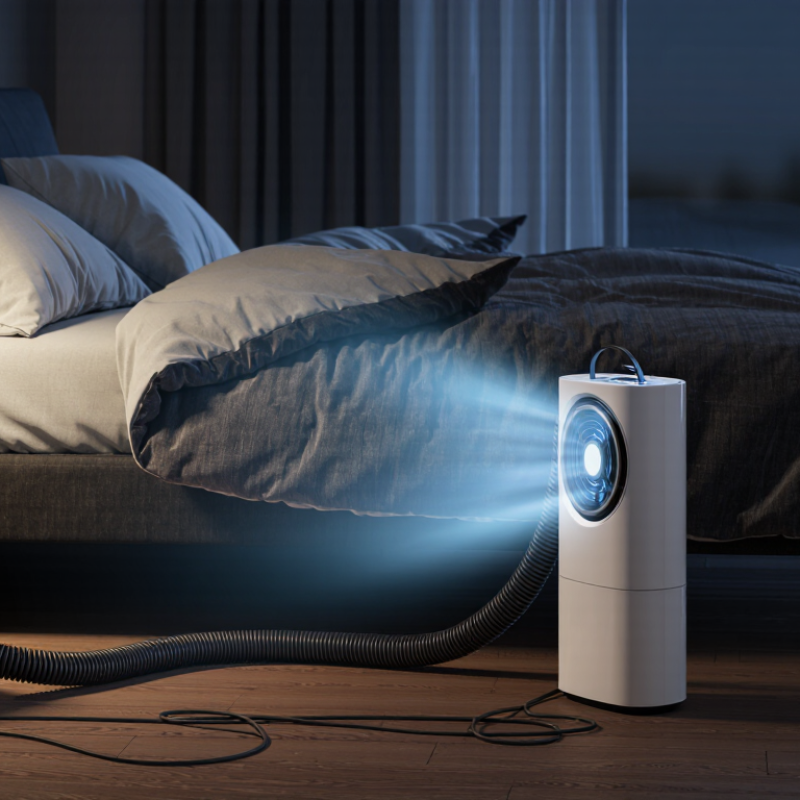
Identify Bed-Fan Types and Fit: Under-Sheet, Mattress, and Bedside Designs
Choosing a bed fan starts with the bed, not the feature list. Under-sheet designs push air between the mattress and top sheet, creating a gentle flow across the body. They suit sleepers who dislike bulky equipment beside the bed. Check the outlet position and sheet fit: tightly tucked bedding can restrict airflow, while loose fabric may shift during the night. Small details matter.
Mattress-style systems sit beneath or within a compatible mattress setup and distribute air over a broader area. They may feel less direct than a nozzle aimed under the sheets, but can work well for couples with different comfort needs. Measure the mattress thickness and confirm the fan’s airflow path before buying. A poor fit can make even a capable unit feel underwhelming. It happens.
Bedside fans are easier to move and adjust. Their airflow reaches the sleeper from the edge of the bed, so placement matters; a nightstand that sits too low may send air into the blankets instead. Listen for motor noise at your usual sleeping distance, and check that cords stay clear of walking paths. It is tempting to choose the strongest setting, but softer, steady airflow may feel more comfortable. Consider your bedding, room layout, and preferred sleep position together.

Compare Airflow (CFM), Noise (dBA), and Wattage Before Buying
How to Choose the Best Bed Fan in 2026?
A bed fan’s airflow rating, measured in CFM, tells you how much air it can move. Higher numbers can help in a warm room, but placement matters too. A fan aimed at your feet may feel different from one aimed beneath the sheets. Compare CFM ratings at similar settings, and check whether airflow can be adjusted. A powerful setting is not always the most comfortable one.
Tips: Check noise ratings in dBA, but note the test conditions. A difference of a few decibels may be noticeable at bedside. Listen for motor hum, rattling, or changing pitch. Quiet matters.
Wattage indicates electrical draw, not cooling strength. To estimate energy use, divide watts by 1,000, then multiply by hours of use and your electricity rate. For example, a 20-watt fan running eight hours uses about 0.16 kWh. I would not choose by wattage alone; efficiency and comfort both count.
One detail is easy to misjudge: published noise and airflow figures may not reflect your room, bedding, or distance from the fan. Compare the specifications, then look for clear testing details and a return option.
Use WHO’s <30 dB(A) Nighttime Bedroom Guideline to Judge Noise
When choosing a bed fan, use the World Health Organization’s nighttime guidance as a room-level reference. It recommends indoor bedroom noise below 30 dB(A) as an eight-hour average for good-quality sleep; maximum events should stay below 45 dB(A). These figures describe the sleeping environment, not a pass-or-fail rating for a fan. A product’s noise figure may come from a different distance or test setting.
Check sound where your head will actually rest. Place the fan as intended, close the bedroom door, and try its lowest and usual settings. Listen for more than loudness: a steady hum may fade into the background, while a repeating rattle or changing pitch can keep drawing attention. Very quiet, too. If you have a sound meter, take a reading near pillow height over several minutes. Phone apps can offer a rough comparison, but they are not calibrated instruments.
Remember that the fan adds to existing sounds, such as an air conditioner or street traffic. I would not reject a fan because one reading sits just above 30 dB(A), nor assume it is sleep-friendly because a listing says “quiet.” Test it during a normal evening, with the room arranged as you use it. The result may differ once the fan is aimed toward the bed or its airflow is increased.
Check UL 507 Safety, Cord Routing, Controls, and Cleaning Access
Choosing the best bed fan in 2026 starts with safety details, not advertised airflow. UL 507 covers electric fans, but a product page saying “tested” is not enough. Check the unit’s label, model-specific documentation, and certification details when UL 507 applies in your market. A missing or unclear label deserves a closer look. The fan should also sit securely and keep its intake and outlet openings unobstructed.
Trace the power cord from the fan to the outlet before setting up the bed. Keep it clear of mattress supports, moving bed parts, and walking paths. Follow the manual’s power instructions rather than improvising a route under rugs or furniture. Controls should be easy to reach in a dark room, with buttons you can distinguish by touch. Small details matter. I would still test the control location at bedtime; what feels reachable during the day may not feel so convenient at night.
Tips: Unplug the fan before cleaning. Check whether you can reach the grille and remove dust without shifting the bed or struggling with hidden screws. A soft brush can help with surface dust, but follow the maker’s care instructions for internal parts. Leave enough space around the unit for inspection and airflow. If cleaning feels awkward during setup, it probably will not get easier later.
How to Choose the Best Bed Fan in 2026
Compare the number of practical checks to make in each area before choosing a bed fan.
How to use this chart: Bar values count the checklist items below; they are not product ratings or test results.
- UL 507 safety (4): Verify certification for the exact model; inspect the plug and cord; check that guards and housing are secure; follow the manufacturer’s placement and operating instructions.
- Cord routing (3): Keep the cord out of walkways; avoid pinching it under furniture; keep it away from rugs, heat, and water.
- Controls (3): Confirm the controls are easy to reach from bed, speed and off settings are clearly identified, and power can be switched off promptly.
- Cleaning access (3): Check that the air intake and grille are accessible, follow the manual’s cleaning instructions, and confirm whether tools are needed for routine cleaning.
Assess Overnight Comfort in Light of AASM’s 7+ Hours of Sleep Guidance
AASM recommends that adults regularly get at least seven hours of sleep. A bed fan cannot create that sleep time by itself, but comfortable airflow may help some people settle and stay asleep. The useful question is not whether a fan feels powerful at bedtime. It is whether it supports comfort through the night without waking you with noise, cold air, or shifting airflow.
Check whether the fan’s direction and speed can be adjusted from bed. A narrow stream aimed at your feet may feel gentler than air blowing across your face. Listen for motor hum in a quiet room, and consider where cords and controls will sit. Small details matter at 3 a.m. Too cold? That happens. A fan that feels pleasant for ten minutes may feel different after several hours.
Assess comfort over several nights, not one warm evening. Note your bedtime, awakenings, room temperature, and whether you felt chilled or sweaty in the morning. Keep other conditions as steady as possible, such as bedding and thermostat settings. This isn’t a clinical sleep assessment, and a simple log can miss things. Still, it can show whether airflow seems helpful or disruptive. If sleep problems persist despite a comfortable setup, consider discussing them with a qualified healthcare professional.
Article Source:
NORTH EASTON MACHINE • 218 Elm Street • North Easton, MA 02356 • 508-238-6219