
How to Choose Copper Foil Flexible Busbar for Your Project?
When it comes to electrical projects, choosing the right components is crucial. One such component is the Copper Foil Flexible Busbar. This product offers unique advantages, making it a popular choice among engineers. Its flexibility allows for easier installation in tight spaces. Additionally, its conductive properties ensure efficiency in power distribution.
Selecting the appropriate Copper Foil Flexible Busbar can be challenging. Considerations include the thickness of the foil, the width of the busbar, and the specific electrical requirements of your project. Not all copper foils are created equal. It's essential to evaluate their thermal management and conductivity ratings thoroughly.
Choosing the wrong type can lead to poor performance or even failure. Be aware of your project’s needs and limitations. The reliability of these busbars is paramount. A thoughtful approach will enhance the overall effectiveness and longevity of your electrical systems.
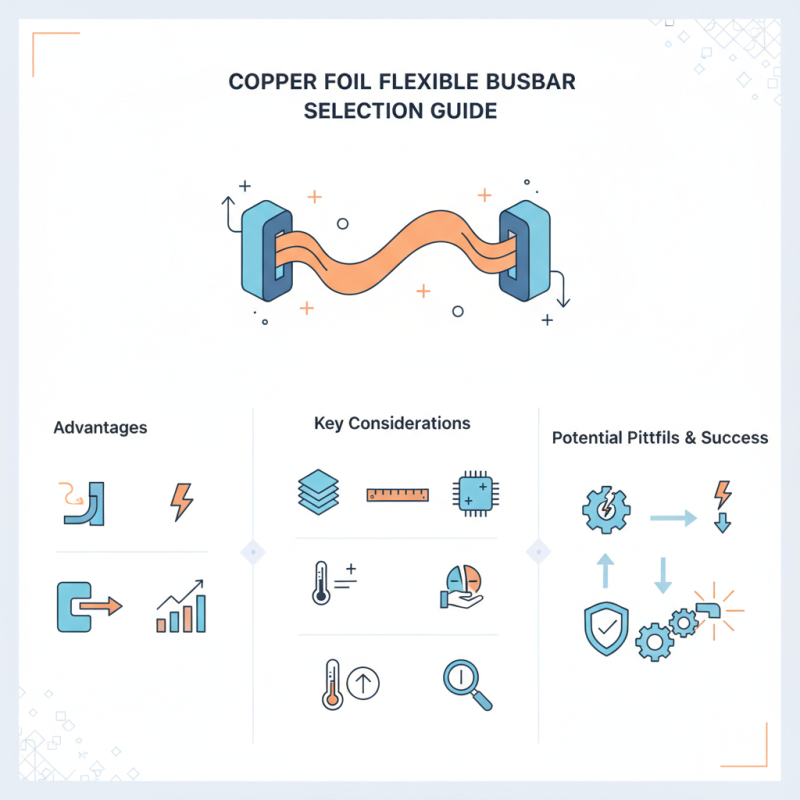
Understanding the Basics of Copper Foil Flexible Busbars
Copper foil flexible busbars are essential in modern electrical applications. These components facilitate efficient power distribution with a compact design. They are made of high-conductivity copper, enabling minimal resistance and heat generation. A study by the International Electrotechnical Commission (IEC) notes that effective busbar usage can improve energy efficiency by up to 20%. Understanding how to select the right specifications for your project is crucial.
When choosing copper foil flexible busbars, consider the operating environment. Physical factors such as temperature fluctuations and humidity levels can affect performance. Look for busbars designed to withstand such conditions. Also, assess the required current capacity. The National Electrical Manufacturers Association (NEMA) recommends a 20% buffer above typical loads for safety. This ensures reliability and longevity.
**Tip:** Always consult with industry experts. Their insights can guide you in choosing the best options for your specific needs. Prioritize quality over cost to avoid future issues.
Inconsistent specifications can lead to project failures. Miscalculating busbar dimensions might result in overheating. Therefore, double-check your measurements. Doing so can save time and resources down the line. Aim for a balance between performance and cost to achieve optimum results.

Evaluating Project Requirements for Copper Busbar Selection
When choosing a copper foil flexible busbar for a project, project requirements play a critical role. The current market analysis indicates that the efficiency of electrical connections can improve significantly with the right selection. A report from the International Copper Association highlights a 20% increase in conductivity when using high-quality copper. This stat emphasizes the necessity of considering not just the basic specifications but also the operational environment.
Evaluate your project's specific needs. Consider factors like current and voltage levels, thermal management, and mechanical stress. A flexible busbar must adapt to installation requirements without compromising performance. According to recent studies, more than 30% of installation failures arise from improper material selection.
Tips: Always consult industry experts or technical datasheets. Take the time to perform thorough calculations. Using simulation software could help anticipate potential issues before they arise. Inspecting physical samples during the decision-making process can also yield valuable insights. This allows for a better understanding of how the busbar will perform in real conditions. Prioritize flexibility in design as unexpected changes can destabilize your project.
Key Factors to Consider When Choosing Copper Foil Thickness
When selecting copper foil thickness for a flexible busbar, several key factors must be considered. The thickness directly impacts current carrying capacity and thermal performance. According to industry reports, a thickness of 0.3mm to 0.6mm typically suffices for most applications, balancing flexibility with electrical conductivity. Users should anticipate the specific requirements of their projects before making a decision. Is the project intended for a high current environment?
Choosing the right thickness involves understanding the electrical load and the environment. A heavier load may require thicker copper foil to prevent overheating. Research from electrical engineering studies suggests that increasing thickness by 0.1mm can enhance thermal dissipation by nearly 10%. However, excess thickness may limit flexibility, complicating installation.
**Tips**: Always verify the expected current ratings against the chosen thickness. Perform heat tests to assess performance under load. Consider the busbar's bending radius; it can affect durability.
It’s crucial to investigate real-world performance and user experiences. Many projects suffer from overheating due to underestimating necessary thickness. Conduct thorough testing when possible to examine whether your choice meets operational demands. Balancing flexibility and conductivity remains essential for optimal performance.
Assessing Electrical Conductivity and Thermal Properties of Busbars
When selecting a copper foil flexible busbar, understanding its electrical conductivity and thermal properties is crucial. Copper is known for its excellent electrical conductivity, typically around 59.6 × 10^6 S/m. This high conductivity ensures minimal energy loss during transmission, which is essential for energy-efficient designs. It's important to consider how the thickness of the copper foil can impact conductivity. Thicker foils can often handle higher current loads but may introduce additional weight.
Thermal properties play a significant role in busbar performance, especially in high-power applications. Copper has a thermal conductivity of approximately 401 W/(m·K), which allows efficient heat dissipation. Nonetheless, poor thermal management can lead to overheating, causing potential failures. In experiments, busbars with inadequate thermal design showed temperature rises over 100°C, indicating a pressing need for optimized layouts and cooling solutions.
Evaluate the specific requirements of your project. Look at how the busbars will be used. Analyze environmental factors, such as temperature fluctuations and exposure to corrosive elements. Remember, the choice of materials and design should reflect both current needs and future scalability. Prioritize reliability and performance to support your project's goals effectively.
How to Choose Copper Foil Flexible Busbar for Your Project? - Assessing Electrical Conductivity and Thermal Properties of Busbars
| Busbar Type | Electrical Conductivity (IACS %) | Thermal Conductivity (W/m·K) | Current Rating (A) | Temperature Coefficient (°C) |
|---|---|---|---|---|
| Standard Copper Foil | 100 | 401 | 200 | 0.004 |
| High Conductivity Copper Foil | 105 | 390 | 220 | 0.0035 |
| Oxygen-Free Copper Foil | 100 | 350 | 180 | 0.0047 |
| Tin-Plated Copper Foil | 95 | 380 | 150 | 0.005 |
| Silver-Plated Copper Foil | 106 | 430 | 250 | 0.0032 |
Exploring Cost-Effectiveness and Supplier Options for Your Project
When considering copper foil flexible busbars, cost-effectiveness is key. Compare the prices of different suppliers. Some may offer lower initial costs but lack durability. Research their materials and manufacturing processes. A cheaper product may lead to higher costs later due to replacements.
Evaluate your project’s specifications. Will you need a tailored solution? Custom options might seem expensive initially but can enhance performance. Consider long-term benefits over upfront savings. Quality products often provide better efficiency and longevity.
Supplier reliability is crucial. Check for reviews and industry certifications. Seek suppliers with a track record of delivering quality. Ask for samples to assess the product firsthand. Don’t overlook warranty options. This can protect your investment. Navigating these choices may feel overwhelming. Trust your instincts and seek advice if needed.
Cost-Effectiveness of Copper Foil Flexible Busbars
Article Source:
NORTH EASTON MACHINE • 218 Elm Street • North Easton, MA 02356 • 508-238-6219