
How to Choose the Best Wafer Roll Machine for Your Business?
Choosing the right Wafer Roll Machine can be daunting. Industry expert John Smith once said, "Quality equipment defines your product." His insight reflects the importance of selecting the best machinery for your business needs.
When considering a Wafer Roll Machine, understand your production scale. Different machines cater to various output levels. It’s crucial to assess your demand to avoid under- or over-investing in equipment. Different models come with unique features. Some may offer intricate designs, while others focus on speed.
Moreover, think about maintenance costs. A cheaper machine might seem tempting but could lead to higher long-term expenses. Not every feature is necessary for all businesses. Reflect on what aligns with your goals. Ensure that your choice not only meets current needs but also accommodates future growth. Decisions about a Wafer Roll Machine require careful thought to avoid costly mistakes.
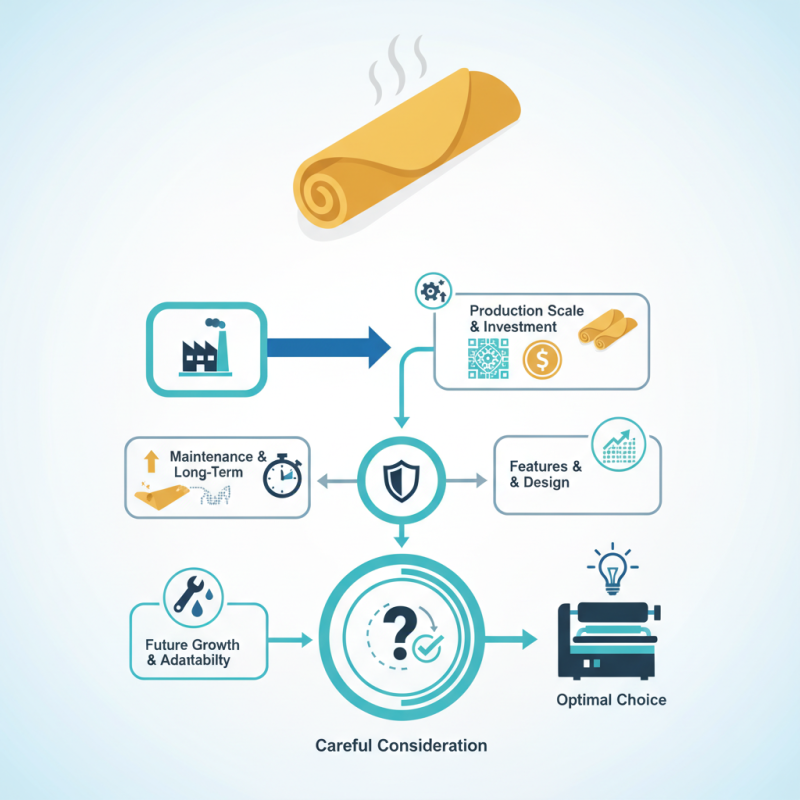
Factors to Consider When Selecting a Wafer Roll Machine for Production
Choosing the right wafer roll machine requires careful thought. Start with the production volume you expect. Machines vary significantly in their output capabilities. A lower-capacity machine might suffice for smaller businesses. However, if growth is in sight, consider a high-capacity model. It’s essential to anticipate future needs.
Next, think about the machine's features. Some machines offer advanced automation, reducing labor costs. Others may have simpler controls, which are easier to operate. Assess your team's experience with technology. An overly complicated machine might lead to mistakes. Look for adaptability. Can the machine handle different recipes or sizes? Flexibility can improve production efficiency.
Material quality is crucial. The build should withstand constant use. Stainless steel is common for durability and hygiene. Don't forget maintenance. Some machines require more frequent upkeep, which can become a hassle. Seek out user reviews to gauge long-term performance. Packing all these factors into your decision can feel overwhelming. It may take time to find the perfect fit for your business.

Production Capacity of Different Wafer Roll Machines
Evaluating the Production Capacity Requirements for Your Wafer Roll Business
When evaluating production capacity for your wafer roll business, it’s crucial to assess your needs carefully. Each production line has a unique output range. Understanding how many wafers you plan to produce daily is essential. For small businesses, a lower capacity machine may suffice. However, scaling up requires more robust options.
Consider your operational hours too. Will you run your machines continuously or intermittently? A high-capacity machine can be wasteful if your output is low. Think about seasonal demands as well. Fluctuations in sales can impact your chosen machine's efficiency.
It’s also worth noting that not all machines will meet your expectations. Some may fall short in consistent quality. Others might require frequent maintenance, impacting production flow. Examine the machine’s specifications closely. Speak to other users if possible. Understanding mixed reviews may save you trouble.
Balancing capacity with reliability is key to success in this competitive market.
Analyzing the Technical Specifications of Different Wafer Roll Machines
Choosing the right wafer roll machine involves understanding its technical specifications. A machine's capacity is crucial. It determines how many rolls you can produce per hour. Higher capacity increases efficiency. However, ensure the machine fits your space. Larger machines might overwhelm smaller operations. Compact models may limit production but save space. Finding balance is key.
Heating methods vary across machines. Some use electric elements, while others rely on gas. Each method has benefits. Electric machines may offer more precise temperature control. Gas can heat up quickly, which is advantageous in busy environments. Make sure to evaluate how consistent the heating is. Inconsistent heating can lead to uneven rolls.
Consider additional features. Temperature controls and timers enhance usability. Digital displays offer clarity but can complicate operation. Simple knobs might be easier but less precise. Reflect on what your team needs. Too many features can create confusion. It’s about finding the machine that suits your production style best.
Cost-Benefit Analysis: Investing in High-Quality Wafer Roll Equipment
Investing in a high-quality wafer roll machine is a big decision. Consider the initial cost versus long-term benefits. High-quality machines often come with better durability. They might save money on repairs and energy over time. A cheaper machine may seem appealing but could lead to higher costs later.
Assess your production needs. Will the machine meet your current demands? How about future growth? A capable machine can help you scale up production. It may handle diverse recipes, enhancing your offerings. Yet, if you overestimate your capacity, it can lead to wasted space and resources.
Tips to remember: Evaluate the energy efficiency of each model. Machines that consume less energy help lower monthly expenses. Look for units that offer versatile functionality. They can adapt to various recipes and customer preferences, boosting profitability. Don't rush your decision. Research is vital.
How to Choose the Best Wafer Roll Machine for Your Business? - Cost-Benefit Analysis: Investing in High-Quality Wafer Roll Equipment
| Feature | Low-End Machine | Mid-Range Machine | High-End Machine |
|---|---|---|---|
| Initial Cost | $5,000 | $15,000 | $30,000 |
| Production Capacity (units/hour) | 100 | 300 | 600 |
| Power Consumption (kW) | 3 | 5 | 8 |
| Maintenance Cost/Year | $1,000 | $500 | $200 |
| Warranty Period (years) | 1 | 2 | 5 |
Maintaining Quality Standards: Choosing Machines That Ensure Product Consistency
In the competitive market of wafer rolls, maintaining product consistency is crucial. A report by the Food Processing Association notes that 73% of consumers prioritize product quality over brand loyalty. This means businesses must invest in machinery that guarantees uniformity in production. A reliable wafer roll machine should offer precise temperature control and consistent dough thickness. Variability in these factors can lead to uneven baking, resulting in unsatisfactory products.
Examining machine specifications is essential. Many machines advertise high output but often compromise on quality control features. For instance, the efficiency of mixing ingredients greatly influences the final product’s texture. Industry data suggests that variations in ingredient homogeneity can alter 30% of the product’s quality.
It's also vital to assess the machine's maintenance needs. Regular upkeep ensures long-term reliability. A well-maintained machine reduces unexpected downtimes, which can disrupt production flow. Inadequate maintenance can lead to costly repairs and quality degradation. Reflecting on these potential pitfalls can help businesses make informed decisions about their machinery investments.
Article Source:
NORTH EASTON MACHINE • 218 Elm Street • North Easton, MA 02356 • 508-238-6219