
China Top 10 Tank Truck Manufacturers in 2026

China’s tank-truck sector is changing quickly. Buyers in 2026 need more than a polished brochure or a low quoted price. A Tank Truck must perform reliably across real routes, payloads, loading cycles, and maintenance schedules. Small details matter: weld consistency, compartment layout, valve access, chassis matching, and the clarity of inspection records. They shape daily operation.

Quality-management expert W. Edwards Deming is widely associated with the principle, “Quality is everyone’s responsibility.” That idea fits tank-truck production: dependable results rely on design, fabrication, component selection, and quality checks working together. This guide reviews ten Chinese manufacturers through practical considerations, including product range, customization, production capability, after-sales support, and available documentation. These points can help fleet buyers compare suppliers more carefully, but they cannot replace a factory audit or equipment-specific technical review. Details vary.

A ranking is useful, but never perfect. Public information can be uneven, and a strong catalogue does not prove consistent field performance. Readers should confirm specifications directly, examine relevant records, and assess whether a manufacturer understands their operating conditions. A tank truck built for one application may not suit another. The following list offers a grounded starting point for evaluating China’s leading manufacturers in 2026—not a promise that one supplier fits every fleet.
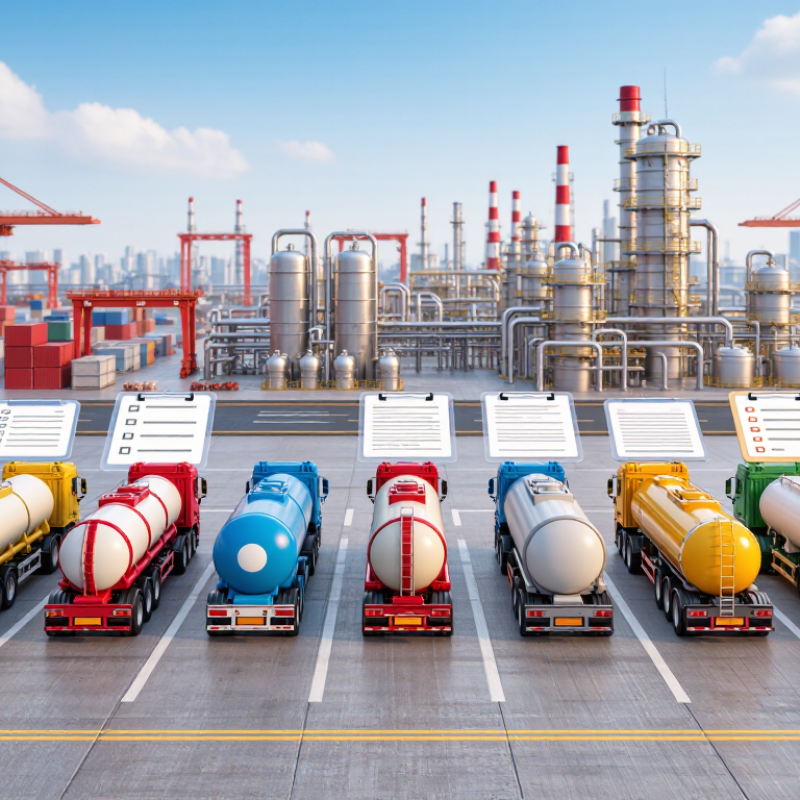
China Top 10 Tank Truck Manufacturers in 2026

Tank Truck Types and China’s 2026 Market Scope

China’s 2026 tank-truck market covers several distinct jobs, not one uniform vehicle segment. Common types include fuel and industrial-liquid tankers, potable-water trucks, food-grade carriers, dry-bulk tankers, and vacuum-service vehicles. Each needs different tank materials, linings, pumps, insulation, or cleaning access. A stainless tank suited to edible oil, for example, is not automatically suitable for every chemical load.

The China Association of Automobile Manufacturers reported 4.031 million commercial-vehicle sales in 2024, up 8.1% year on year. This is useful market context, but it is not a tank-truck sales figure. Public data rarely separates tank trucks consistently by cargo and body type. That gap matters. Buyers should assess replacement demand, local freight activity, vehicle configuration, and service access rather than treating broad truck growth as a direct forecast.

Powertrain choices are also shifting. The International Energy Agency’s Global EV Outlook 2025 reported nearly 80% growth in global electric-truck sales in 2024. That points to wider electrification, not proof that every tanker route is ready for it. Short urban water or food-delivery routes may be easier to electrify than long-distance operations. The distinction is practical: payload, operating range, charging time, and pump energy all affect the real choice. Some market assumptions remain uncertain. That deserves a closer look.

Ranking Criteria: 2025 Output, Export Reach, Certifications, and Service

A credible “China Top 10 Tank Truck Manufacturers in 2026” ranking should start with verified 2025 deliveries, not factory capacity alone. The China Association of Automobile Manufacturers reported 3.804 million commercial vehicles produced in 2024. That figure provides useful industry context, but it does not isolate tank trucks. A fair comparison should therefore request shipment records, production logs, and model-level delivery evidence. Paper capacity can look impressive.

Export reach needs careful measurement. UN Comtrade’s HS 8704 category covers goods vehicles broadly; it cannot independently confirm tanker exports. Rankings should cross-check customs records with destination markets, repeat orders, and delivery documentation. The World Bank’s 2023 Logistics Performance Index compares 139 economies across six logistics dimensions. It offers route and logistics context, not a direct score for manufacturers.

Certifications should be checked for scope, validity, and relevance to each vehicle configuration. A certificate for a factory management system does not prove every tank model meets a buyer’s requirements. Service also deserves measurable criteria: parts availability, technician coverage, response times, and maintenance guidance. Ask for records, not promises. These measures are imperfect; public data rarely separates tank-truck output from other commercial vehicles. That limitation should remain visible in the ranking, rather than being hidden behind precise-looking scores.

Safety Standards: GB 18564.1-2019 and GB 18564.2-2019

For buyers comparing China’s top tank truck manufacturers in 2026, GB 18564.1-2019 and GB 18564.2-2019 offer an important starting point. The first covers metal atmospheric-pressure tanks for road transport of liquid dangerous goods. The second covers non-metallic atmospheric-pressure tanks. Their different material requirements mean buyers should match the applicable standard to the tank’s construction, not rely on a generic compliance claim.

Ask for documents that connect the finished vehicle to its design and production checks. Useful records may include material traceability, weld inspection results, and applicable pressure or leak-test reports. Inspect manhole covers, valves, pipe connections, and supports for clear identification and sound workmanship. Small details matter. A polished exterior proves little about internal quality. Requirements also depend on the tank type and intended service, so confirm the relevant clauses with qualified technical personnel. A checklist can still miss practical issues; I would also review maintenance access and how inspection findings are recorded over time.

Emissions Benchmark: China VI Heavy-Duty Diesel Rules Since July 2021

Since July 1, 2021, China VI has applied nationwide to newly sold heavy-duty vehicles, including diesel chassis used for tank trucks. The standard tightens limits for pollutants such as nitrogen oxides and particulate matter. It also raises expectations for emissions testing and system durability. Tank capacity is only one part of a sound purchase decision. Details matter.

China VI checks emissions under controlled test conditions and includes on-road verification using portable measurement equipment. This helps reveal differences between laboratory results and real driving. After-treatment systems and onboard diagnostics are therefore important, not merely technical extras. A tanker that spends hours idling or makes frequent short trips may place different demands on its emissions equipment than one used mainly on highways.

A clean specification sheet is reassuring, but it is not the whole story. Ask how warning lights, filter regeneration, and scheduled maintenance are handled. A fault appearing after repeated short urban trips can interrupt work and require skilled diagnosis. Service records help, too. They show whether sensors and emissions components received attention over time. On paper, compliance looks tidy. Daily operation can be less tidy. A practical assessment should consider the truck’s route, load, and maintenance support alongside its certified emissions level.

China Top 10 Tank Truck Manufacturers in 2026 - Emissions Benchmark: China VI Heavy-Duty Diesel Rules Since July 2021

Regulatory benchmark for heavy-duty diesel engines used in tank-truck chassis. This table summarizes emissions rules and implementation milestones; it is not a manufacturer ranking or a company-specific assessment.

No. Benchmark dimension China VI reference Relevance to tank trucks
1 National emissions standard GB 17691-2018, “Limits and measurement methods for emissions from diesel fuelled heavy-duty vehicles (China VI).” Provides the emissions framework for applicable heavy-duty diesel engines and vehicles; the tank body does not replace chassis or engine compliance.
2 China VI-a nationwide milestone From 1 July 2021, China VI-a requirements applied nationwide to newly produced, imported, and sold heavy-duty diesel vehicles covered by the implementation rules. Relevant when assessing the regulatory baseline for heavy-duty diesel tank-truck chassis introduced from this date.
3 China VI-b nationwide milestone China VI-b was implemented nationwide for applicable heavy-duty vehicles from 1 July 2023. For vehicles placed on the market after the applicable transition, check the engine and vehicle documentation for the required stage.
4 Transient engine test cycle The World Harmonized Transient Cycle (WHTC) is used for applicable engine type-approval testing. Measures emissions across a changing engine operating pattern rather than at a single steady load.
5 Steady-state engine test cycle The World Harmonized Steady-state Cycle (WHSC) is used for applicable engine type-approval testing. Complements transient testing with measurements at defined steady operating points.
6 Carbon monoxide (CO) limit For diesel engines, the China VI limits are 4.0 g/kWh on WHTC and 1.5 g/kWh on WHSC. These are engine-test limits, not a direct measurement of emissions from the tank body or a complete vehicle in every operating condition.
7 Nitrogen oxides (NOx) limit For diesel engines, the China VI limits are 0.46 g/kWh on WHTC and 0.40 g/kWh on WHSC. Engine calibration and the approved emissions-control system are central to meeting the applicable test limits.
8 Particulate matter (PM) limit The China VI diesel-engine PM limit is 0.01 g/kWh on both WHTC and WHSC. PM compliance is assessed under the prescribed test procedures and approved engine configuration.
9 On-board diagnostics (OBD) China VI includes OBD requirements for monitoring relevant emissions-control systems and detecting specified malfunctions. For fleet operation and maintenance, diagnostic alerts should be handled in line with the vehicle and engine maker’s service instructions.
10 In-service conformity China VI includes in-service conformity requirements; applicable checks can use portable emissions measurement systems (PEMS) under prescribed procedures. Type approval alone does not describe every in-use check; maintenance, operating condition, and regulatory procedures also matter.

Source basis: China national standard GB 17691-2018 and the national implementation timetable for China VI heavy-duty vehicle emissions requirements. Limits shown are engine test-cycle values; confirm the applicable vehicle category, implementation provisions, and certification documents for a specific vehicle.

Profiles of China’s Top 10 Tank Truck Manufacturers in 2026

The profiles of China’s leading tank truck manufacturers in 2026 are most useful when they show more than production capacity. Buyers should look for clear details about tank materials, welding methods, compartment layouts, and chassis options. These choices affect payload, cleaning access, and daily maintenance. Details matter.

Some manufacturers focus on liquid transport, while others build vehicles for food-grade cargo, water, or dry bulk. A strong profile explains how each design fits its intended work. It should also describe inspection procedures, quality records, and the availability of replacement parts. General claims are easy to make; practical evidence is more informative. Ask whether specifications refer to standard models or custom builds.

After-sales support deserves equal attention. Response times, technician training, and access to service manuals can influence how quickly a truck returns to work. Factory visits and sample inspection reports may help verify published information. Still, comparisons are rarely perfect: equipment packages vary, and published data may not include every operating condition. Readers should treat rankings as a starting point, then confirm details against their routes, cargo, and maintenance resources.

Certified Quality System

© North Easton Machine Company, Inc. All rights reserved. • Site: Blog
NORTH EASTON MACHINE • 218 Elm Street • North Easton, MA 02356 • 508-238-6219