
China Best Control Circuit Board Suppliers for Global Buyers
Global buyers need more than a supplier’s polished catalogue when sourcing a Control Circuit Board. They need evidence that the board can meet its electrical, mechanical, and production requirements. A clear review should consider engineering support, component traceability, manufacturing capacity, inspection methods, and communication across time zones. These details matter when a prototype becomes a production run. A neat sample is useful, but it cannot prove consistent quality by itself.
Veteran analog engineer Bob Pease famously joked, “My favorite programming language is solder.” The line is playful, yet it points to a practical truth: circuit design must work in the physical product, not only on a screen. For buyers, that means asking how suppliers handle layout reviews, assembly checks, and changes between revisions. No supplier is perfect. A quick quotation or attractive price may still leave important questions unanswered. This guide examines China-based Control Circuit Board suppliers through the factors global buyers can verify, rather than relying on broad claims. It is also worth admitting that supplier comparisons have limits; the right choice depends on the application, order volume, and support required after delivery. Look closely. Ask for evidence. Then decide.
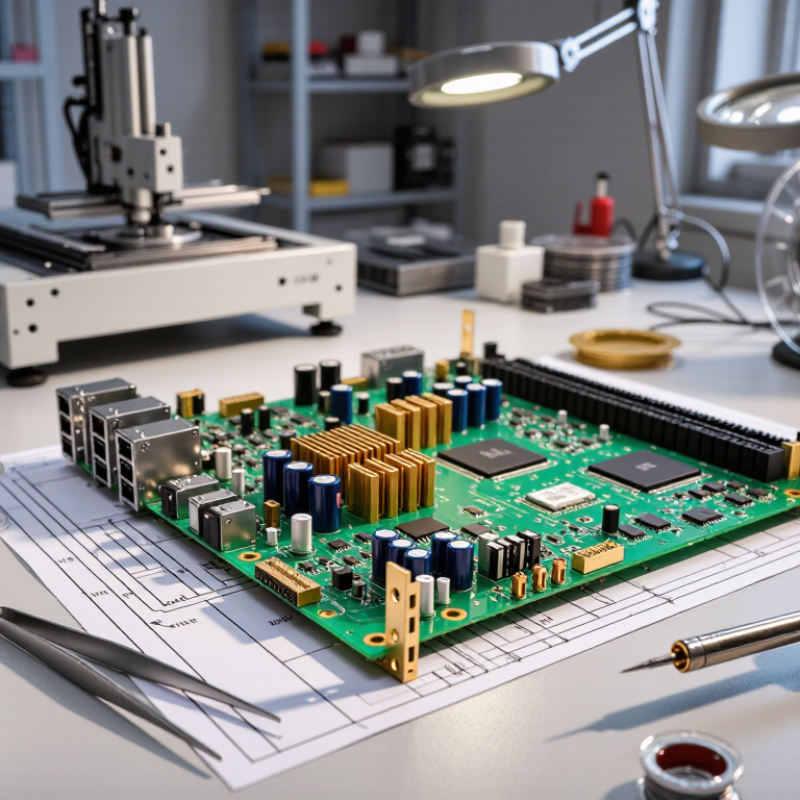
What Control Circuit Boards Are and Where They Are Used
A control circuit board is an assembled electronic board that manages a device’s functions. Copper tracks connect components such as processors, sensors, and relays. The board reads input signals, applies programmed logic, and sends commands to motors, valves, displays, or power circuits. Small board, critical job. Its design depends on operating conditions, including vibration, heat, moisture, and electrical noise.
These boards appear in factory automation, HVAC equipment, medical instruments, home appliances, vehicles, and energy systems. In a packaging line, for example, a board can read a photoelectric sensor and stop a conveyor when a carton reaches a set position. The International Federation of Robotics reported 4,281,585 industrial robots operating worldwide in 2023 in World Robotics 2024. That figure illustrates the scale of automated equipment, though it does not measure circuit-board demand.
Vehicle electronics are another major application. The International Energy Agency’s Global EV Outlook 2024 reported nearly 14 million electric-car sales in 2023, around 18% of global car sales. Control boards help coordinate functions such as battery monitoring and power conversion. A useful caution: one board rarely controls an entire complex system alone. Multiple boards may exchange signals, and a small change in temperature or wiring can affect performance. That detail is easy to overlook.
| Board Type | What It Does | Typical Construction | Common Applications | Key Requirements to Specify | Supplier Evaluation Points |
|---|---|---|---|---|---|
| General-Purpose Control Board | Processes inputs from switches or sensors and controls outputs such as relays, indicators, and small actuators. | Usually a rigid FR-4 printed circuit board with surface-mount and/or through-hole components; may include a microcontroller and connectors. | Appliances, instrumentation, access systems, and small industrial equipment. | Input/output count, supply voltage, connector type, board dimensions, firmware interface, and operating temperature range. | Check schematic and PCB design support, component sourcing controls, assembly inspection, and functional-test coverage. |
| PLC I/O and Interface Board | Connects field devices to a programmable logic controller or other industrial controller, conditioning signals and isolating interfaces where required. | May include digital or analog input circuits, output drivers, protection components, terminal blocks, and isolation devices. | Factory automation, process control panels, packaging machinery, and material-handling systems. | Signal types, channel count, isolation requirements, surge protection, terminal arrangement, and applicable environmental conditions. | Review test fixtures, traceability, workmanship controls, and the supplier’s ability to build to the released design and revision. |
| Motor Control Board | Controls motor start, speed, direction, or protection; the design may use relays, switching devices, or a dedicated drive stage. | Construction varies with motor type and power level. Higher-power designs may require wider copper paths, thermal management, and additional electrical clearances. | Pumps, fans, conveyors, household equipment, and industrial machinery. | Motor type, voltage and current, switching method, protection features, thermal limits, and required control signals. | Assess power-electronics assembly experience, thermal and electrical test capability, component handling, and documented inspection criteria. |
| Power Control and Distribution Board | Routes or switches electrical power and may provide regulation, protection, or monitoring for connected circuits. | May combine control electronics with higher-current paths, fuses, relays, connectors, or power-conversion components. | Power supplies, lighting systems, battery-powered equipment, and industrial control cabinets. | Input and output ratings, load current, protection strategy, creepage and clearance needs, thermal design, and applicable safety standards. | Confirm electrical test procedures, material and component traceability, soldering controls, and support for compliance documentation. |
| HVAC and Environmental Control Board | Coordinates sensors, user settings, and outputs used to regulate heating, ventilation, air conditioning, or related equipment. | Typically includes a microcontroller, sensor interfaces, communication connections, and relay or low-voltage output circuits. | Air conditioners, heat pumps, ventilation units, refrigeration equipment, and building-control systems. | Sensor types, communication protocols, supply voltage, relay ratings, temperature and humidity exposure, and enclosure requirements. | Check environmental test planning, firmware-programming controls, functional testing, and consistency between production and approved samples. |
| Safety and Protection Board | Monitors defined conditions and initiates a protective response, such as disabling an output or signaling a fault. | Can include monitoring circuits, redundant or supervised inputs, protection components, and status indicators, depending on the application. | Industrial equipment, battery systems, chargers, and machinery protection circuits. | Required safety function, fault response, monitoring range, isolation, diagnostic behavior, and relevant regulatory requirements. | Evaluate design-document control, process validation, test records, change management, and the ability to meet application-specific quality requirements. |
| Communication and Gateway Board | Transfers control data between a device and external systems or networks. | May use wired interfaces such as Ethernet, CAN, RS-485, or USB, or wireless modules, depending on the design. | Connected equipment, building automation, industrial monitoring, and remote-control products. | Interface standards, connector and antenna needs, data rate, isolation, electromagnetic compatibility, and firmware-loading method. | Review controlled handling of programmed components, interface testing, electromagnetic compatibility support, and production test records. |
| Flexible or Rigid-Flex Control Circuit | Provides electrical connections where a product needs a flexible interconnect or a combination of rigid and bendable sections. | Uses flexible polymer substrates, often polyimide; rigid-flex designs combine flexible sections with rigid board areas. | Compact instruments, moving assemblies, displays, medical devices, and products with limited installation space. | Layer stack-up, bend radius, bend-cycle expectations, copper type, stiffener locations, and connector or mounting details. | Confirm experience with the specified materials and stack-up, fabrication capability, inspection methods, and handling requirements. |

Certified Quality System

 Find Your Solutions ▶
NORTH EASTON MACHINE • 218 Elm Street • North Easton, MA 02356 • 508-238-6219