
7 Cascade Retort Buying Tips for Global Buyers
A Cascade Retort can help processors heat packaged foods efficiently, but equipment selection is not a simple capacity comparison. Buyers must examine package format, loading pattern, target throughput, temperature control, water circulation, and local service support. Small details matter: a basket that fits the chamber may still slow loading or complicate changeovers. The right questions begin before a quotation arrives.
Market data offers useful context, not a purchasing verdict. Grand View Research’s Retort Packaging Market Size, Share & Trends Analysis Report estimated the global retort packaging market at about US$4.6 billion in 2023, with projected growth through 2030. That estimate covers packaging, not Cascade Retort equipment sales, so it should not be mistaken for a machine-demand forecast. PMMI’s 2024 State of the Industry report also discusses automation and investment pressures across packaging operations. These reports point to a changing market, but they cannot assess a specific plant’s utilities or product mix.
That is where careful buying begins. Ask suppliers for documented operating ranges, reference installations, maintenance requirements, and evidence that the proposed system suits your actual containers. Compare usable capacity, not just brochure figures. Details matter. A short factory visit can reveal loading ergonomics, control-screen clarity, and how operators handle routine checks. No supplier can remove every risk; buyers should record assumptions and verify them with qualified process and engineering professionals. The seven tips ahead offer a practical framework for comparing proposals, spotting unanswered questions, and choosing a Cascade Retort that fits real production conditions—not an idealized spreadsheet.
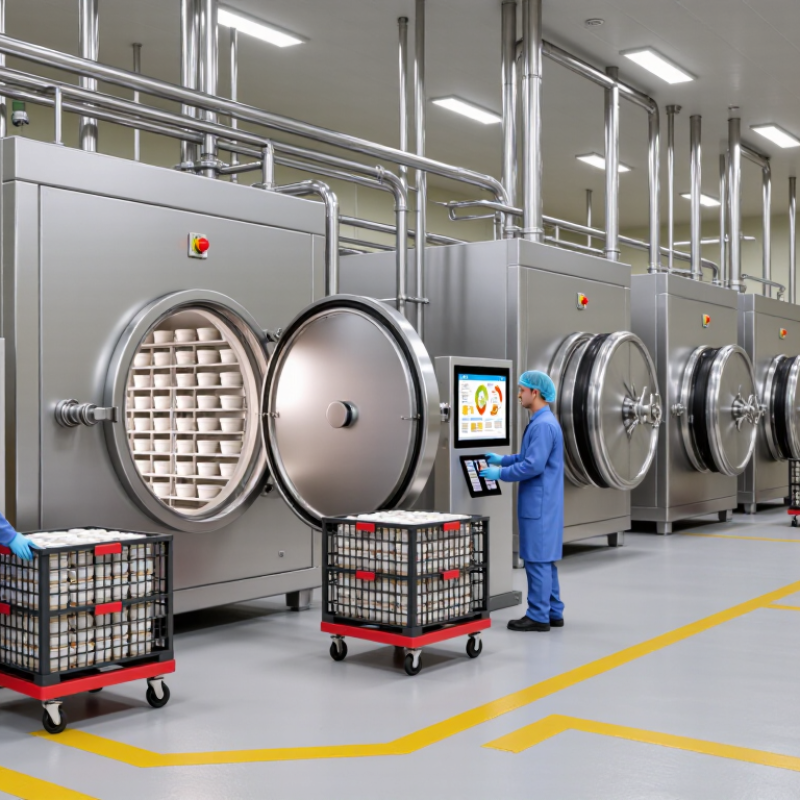
Define Product and Pack Needs: Use the 12D Botulinum Benchmark Carefully
A cascade retort should be specified around the product and package, not a headline temperature. Record the formulation, fill weight, headspace, pack dimensions, closure type, and initial product temperature. A thick sauce in a deep tray heats differently from clear liquid in a shallow pouch. Small changes matter. Ask suppliers how the retort controls water circulation, pressure, and product movement for your exact pack.
The 12D botulinum benchmark is a reference for process design, not a ready-made cycle. The FDA’s Guide to Inspections of Low-Acid Canned Food Manufacturers describes the conventional basis: a D-value of about 0.21 minutes at 121.1°C gives roughly 2.5 minutes for a 12-log reduction, under stated assumptions. That figure is not the total retort time. Product composition, package geometry, and the measured cold spot affect delivered lethality. FDA regulation 21 CFR 113.83 requires scheduled processes to be established by qualified process authorities. Real packs vary.
Tip: Request heat-penetration data for your product and pack, including cold-spot locations and F₀ values. Check whether trials used your actual fill and loading pattern. A neat spreadsheet is useful, but it cannot replace a validated process. Keep the assumptions visible, and revisit them when ingredients or packaging change.

Validate Heat Performance: Measure F₀ at the 121.1°C Reference Temperature
For global buyers, a retort display reading of 121.1°C does not prove that every container received the intended heat treatment. Ask how the supplier validates temperature distribution and product heat penetration. Place calibrated sensors at mapped cold spots, including inside representative containers, and test the fullest approved load. Small details matter: container size, fill weight, product viscosity, and loading pattern can change heating behavior.
F₀ expresses accumulated lethality relative to 121.1°C, commonly using a z-value of 10°C. It accounts for the temperature history over time, not just the holding period. The calculation should include relevant heating and cooling phases, with the measurement location and assumptions clearly documented.
Request raw time-temperature records, calibration certificates, and the method used to identify the cold spot. Look closely.
A strong validation package connects the measured F₀ to the specific product, container, and scheduled process. One number is not enough. F₀ does not, by itself, establish that a process is appropriate for every formulation or load. Ask who reviewed the study and how deviations are handled. It is tempting to compare machines by their maximum temperature, but that can miss uneven heating. Even careful tests have limits; confirm that routine production checks reflect the validated conditions.
Compare Cascade Designs: Check Water Coverage, Overpressure, and Load Capacity
Compare cascade retort designs by how water reaches every package, not by pump size alone. Ask for water-distribution results from representative production loads. A clear view helps. Check coverage at basket edges, beneath dividers, and between tightly packed pouches or cans. Request temperature-distribution data from identified cold spots, including the top and bottom of the load. A diagram can mislead. Verify performance with your container, spacing, and loading pattern, since small changes can redirect water flow.
Check how the system controls overpressure during heating and cooling. Pressure must follow the process profile closely enough to limit package deformation or seal stress. Ask how sensors, alarms, and control settings respond to pressure deviations. Test both. Review records from trials using your most pressure-sensitive packaging, not only rigid containers. A short demonstration may not reveal unstable control during a full cycle.
Compare usable load capacity, rather than relying only on the stated maximum basket weight. Confirm the number of baskets, package spacing, and required circulation paths at full load. Ask whether the pump and heating system maintain even coverage when baskets are densely packed. Small loads matter too; they can behave differently from full ones. Request cycle data for both conditions, and check that loading and unloading space fits your production floor. Some details are easy to overlook.
| Buying Check | What to Compare | Evidence to Request | Why It Matters |
|---|---|---|---|
| 1. Water coverage | How evenly recirculated process water reaches the specified load arrangement, including the top, bottom, edges, and areas between containers. | Water-distribution test results or temperature-mapping data from a representative, fully loaded retort configuration. | Uneven water distribution can contribute to temperature differences across the load. Ask how the proposed basket arrangement and product containers were represented in the test. |
| 2. Overpressure control | Available pressure-control range, measurement accuracy, control response, and how pressure is coordinated with temperature and the process schedule. | Control-system description, pressure and temperature records, and a documented operating procedure for the intended package type. | Overpressure may be used to help protect flexible or semi-rigid packages from excessive pressure differences during processing and cooling. The required settings depend on the package and validated process. |
| 3. Usable load capacity | Maximum usable basket or rack dimensions, allowable load mass, container spacing, and the actual number of containers per validated load pattern. | Dimensioned drawings, load-layout examples, rated limits, and a representative loading plan for your containers. | Rated vessel volume alone does not establish production capacity. Spacing, circulation paths, container size, and load limits affect the usable quantity per cycle. |
| 4. Temperature uniformity and process validation | How the retort is tested under the proposed operating conditions, including the product, container, load pattern, and process temperature. | Temperature-distribution and heat-penetration study documentation, plus the proposed plan for process validation by qualified personnel. | Commercial thermal processing needs a process appropriate to the specific product and package. Equipment specifications alone do not establish a safe scheduled process. |
| 5. Water and energy use | Water consumption, heating demand, heat recovery provisions, and utility requirements per cycle under stated operating assumptions. | Utility-consumption estimates with the test conditions clearly stated, including batch size, starting temperatures, and cycle assumptions. | Comparisons are meaningful only when the operating conditions are comparable. Confirm local water, steam, electricity, and drainage capacity before purchase. |
| 6. Instrumentation and records | Temperature and pressure sensors, alarm handling, data recording, user access, and provisions for calibration and record review. | Instrument list, calibration procedures, sample cycle records, alarm descriptions, and details of data export and retention. | Reliable instruments and traceable cycle records support process oversight, troubleshooting, and quality-system documentation. |
| 7. Installation, service, and compliance | Site requirements, applicable pressure-equipment rules, operator training, spare-parts availability, and service response in the destination country. | Installation requirements, jurisdiction-specific compliance documentation, maintenance schedule, training plan, and written service terms. | Requirements vary by country and installation. Confirm applicable regulations and local inspection needs with the relevant authorities and qualified professionals before ordering. |
Verify U.S. Compliance: 21 CFR Part 113 Requires a Scheduled Process
A cascade retort should be evaluated against the process it must run, not just its advertised capacity. Under 21 CFR Part 113, processors of low-acid foods in hermetically sealed containers must use a scheduled process established by a qualified person. Buying compliant-looking equipment is not enough. The process depends on details such as product formulation, container size, fill weight, initial temperature, and loading pattern.
Ask suppliers for operating data that shows the retort can consistently meet your process requirements. For a cascade system, review how water distribution, temperature control, and container loading are managed. Check that temperature sensors and recording devices can be calibrated, and that records capture the critical process conditions. Small details matter. A neat demonstration with empty baskets proves little about a full production load.
Have a qualified thermal-process expert assess the proposed equipment and product setup before purchase. Confirm who will conduct any needed heat-distribution or process studies, and what documentation you will receive. I would not treat a sales sheet as proof; that shortcut is tempting, but it leaves important questions unanswered. Even a capable retort can fall short if the scheduled process was developed for different containers or loading conditions. The paperwork can feel tedious. It is still part of the decision.
Estimate Global Lifecycle Costs: Compare Throughput, Utilities, and Service
A cascade retort can look economical on purchase day and costly after years of uneven production. Compare lifecycle costs using your actual product mix, batch size, shifts, and annual operating days. Do not treat rated capacity as guaranteed output. Basket loading, heating time, cooling, and changeovers can reduce usable throughput. Ask for cycle records from comparable loads, then check the assumptions with a practical trial where possible.
Measure steam or electricity per batch, along with water and compressed-air use. Compare consumption against local utility rates, including demand charges and seasonal price changes. Include the energy needed for cooling and any supporting equipment. Small differences matter. A spreadsheet can help compare cost per saleable unit, but only if its inputs reflect real production. Keep estimates adjustable; utility prices and output rarely stay fixed.
Service costs also shape the total. Request preventive-maintenance schedules, typical replacement-part lists, and expected technician response times for your operating region. Account for shipping, travel, staff training, and planned downtime. Check what routine tasks your team can perform safely, and which require specialist support. Check the details. A low service estimate may rely on optimistic assumptions, so record what remains uncertain and revisit it after the first months of operation.
Article Source:
NORTH EASTON MACHINE • 218 Elm Street • North Easton, MA 02356 • 508-238-6219