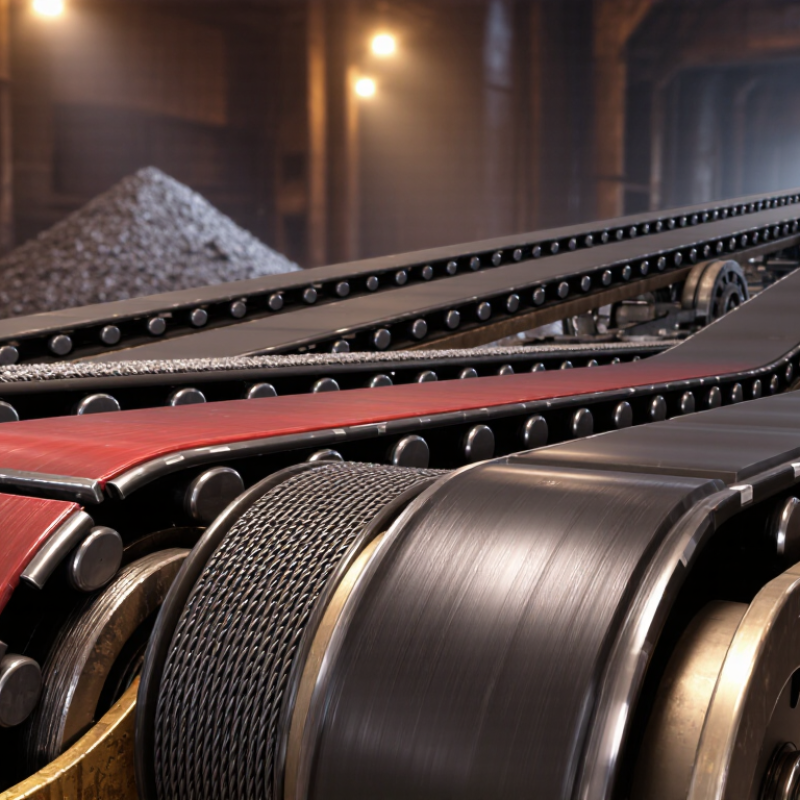
What Are the 2026 Top Types of Steel Cord Conveyor Belts?
In 2026, Steel Cord Conveyor Belts remain essential for mines, ports, power plants, and high-capacity material handling systems. Their steel reinforcement supports long distances, heavy loads, and demanding operating conditions. Yet, choosing the right belt is not simply a matter of selecting the highest tensile strength. Real performance depends on belt width, cover grade, splice design, pulley diameter, trough angle, and maintenance quality.
The leading types include ST-class belts for extreme tensile demands, fire-resistant belts for underground and enclosed facilities, abrasion-resistant belts for sharp ores, and oil-resistant belts for contaminated materials. Low-rolling-resistance designs are also gaining attention because they can reduce energy consumption across long conveyors. Some manufacturers now combine stronger steel cords with improved rubber compounds and digital monitoring systems. Small details matter. A damaged edge can reveal a larger alignment problem.
R. Todd Swinderman, a respected conveyor reliability specialist, is widely associated with the practical warning, “Conveyor belts do not fail; they are failed.” This idea remains useful when evaluating the 2026 market. Belt selection cannot replace accurate installation, controlled loading, regular inspections, and disciplined splicing. In practice, even an advanced belt may underperform when cleaners are poorly adjusted or moisture enters the splice area. That is the uncomfortable part. Technology helps, but it does not remove human error. This guide examines the top Steel Cord Conveyor Belts types expected to lead in 2026, comparing their construction, applications, durability, energy performance, and maintenance demands.
What Defines a Steel Cord Conveyor Belt in 2026?
In 2026, a steel cord conveyor belt is defined by its internal reinforcement, not its appearance. Parallel steel cords run through the rubber carcass and carry extreme longitudinal tension. This structure supports long conveyors, steep lifts, and heavy mineral loads. Low elongation also reduces take-up movement during operation. The belt still needs carefully engineered rubber covers, edge protection, and a reliable splice.
The leading types differ by operating conditions. High-tensile belts suit long-distance routes and high-capacity loading points. Abrasion-resistant versions handle sharp rock and repeated impact. Heat-resistant constructions serve hot materials, while oil-resistant covers protect belts in contaminated environments. Fire-resistant performance may also matter in enclosed facilities. Selection should follow verified tensile data, cover-grade tests, splice procedures, and recognized conveyor-belt standards.
A belt can look perfect outside. Internal cord damage may remain hidden. That is why modern inspections increasingly combine visual checks, belt-scanning systems, thickness measurements, and recorded maintenance history. These tools help identify broken cords, corrosion, mistracking, and early cover wear before failure develops. However, monitoring is not magic. Poor loading, weak cleaning routines, or an incorrect splice can shorten service life quickly. The practical definition of a quality steel cord belt is therefore broader than its steel strength. It includes tested materials, controlled manufacturing, installation accuracy, and evidence from real operating conditions. The industry still debates which design is “top.” In practice, the strongest choice depends on the conveyor, material, climate, and maintenance discipline.
What Are the 2026 Top Types of Steel Cord Conveyor Belts?
What Defines a Steel Cord Conveyor Belt in 2026?
Steel cord conveyor belts are defined by longitudinal steel cords embedded in rubber, providing high tensile strength, low elongation, and long conveying distances. The chart shows representative ISO 15236/DIN strength classes, expressed as nominal belt tensile strength in kN/m. Higher classes are typically selected for heavier loads, longer conveying routes, steeper lifts, and demanding bulk-material applications. These values describe standardized belt strength classes rather than company market share or sales performance.
How Steel Cord Conveyor Belts Are Classified by Design
What Are the 2026 Top Types of Steel Cord Conveyor Belts?
Steel cord conveyor belts are mainly classified by their internal design. The most common type uses parallel longitudinal steel cords for high tensile strength. It suits long-distance conveyors, steep lifts, and heavy mineral loads. Cord spacing, diameter, and rubber penetration determine how the belt handles tension and impact.
A second design is the transverse-reinforced steel cord belt. It adds crosswise steel wires beneath the top cover. This structure improves resistance against sharp rocks, falling material, and edge damage. Some belts also include rip-detection loops, which help monitoring systems identify longitudinal cuts. These features increase protection, but they may require more careful splicing and inspection.
The cover and edge design create further categories. Belts may have abrasion-resistant covers, heat-resistant compounds, or oil-resistant surfaces. Closed edges protect cords from moisture, while cut edges can simplify certain manufacturing and repair processes. Pipe conveyor belts use a flexible arrangement that forms a sealed tube during operation. This reduces dust and material loss around curves.
In field inspections, small differences in cord alignment often affect tracking and splice quality. Classification is not perfectly clean. A belt may combine several designs. Engineers should verify construction details against ISO 15236, load calculations, pulley diameters, and site conditions before selection. A thicker cover is not always better. It can increase weight, bending resistance, and replacement costs.
Which Steel Cord Belt Types Lead in 2026?
In 2026, leading steel cord conveyor belts include high-tensile, rip-resistant, heat-resistant, and energy-saving designs. High-tensile belts remain vital for long overland conveyors and deep mining routes. They carry heavy loads while limiting belt length and transfer points. Their steel cords need accurate spacing and reliable rubber adhesion.
Rip-resistant belts are gaining attention where sharp rock can damage the carrying side. Reinforced transverse breakers help slow a tear after impact. This feature matters near crushers, loading zones, and poorly controlled feed points. Heat-resistant types serve clinker, sintered material, and other hot products. Their cover compounds must match the actual material temperature, not a guessed average. That detail is often missed.
Energy-saving steel cord belts are also leading new projects. Lower rolling resistance can reduce power demand across long routes. Yet performance depends on idler alignment, belt tension, and loading consistency. A premium belt cannot correct weak maintenance. Oil-resistant and abrasion-resistant versions remain practical for specific materials. They should be selected from test data and site records. I have seen specifications look impressive, then fail under unexpected moisture and impact. The lesson is uncomfortable: belt type alone does not guarantee service life. Some 2026 designs may be over-engineered for short conveyors, wasting capital without improving uptime.
How Each Belt Type Performs in Different Industries
What Are the 2026 Top Types of Steel Cord Conveyor Belts?
In 2026, steel cord conveyor belts serve demanding industries with different priorities. Standard high-tensile belts suit mining and bulk material terminals. They carry heavy loads across long distances with limited elongation. Their steel cables support stable tracking and fewer take-up adjustments. Open-pit mines often use them for crushed stone, coal, and metallic ore. However, poor splicing can damage even the strongest belt.
High-impact belts perform well in quarrying and underground mining. Their reinforced covers resist cuts from sharp rock and sudden loading. Flame-resistant versions support coal handling and enclosed industrial areas. They require correct testing and maintenance under local safety rules. Oil-resistant belts fit ports, recycling plants, and fertilizer facilities where greasy materials soften ordinary rubber. Pipe conveyor belts protect dusty materials and reduce spillage near farms, cement plants, and urban routes. They cost more, but cleaner transfer points may justify the investment.
Tips: Match belt strength to the real load, not the advertised maximum. Inspect pulley alignment, cleaners, and splice condition regularly. Measure moisture, heat, oil, and impact before selecting the cover grade. A wider belt is not always better. In practice, maintenance habits can matter more than belt specifications. That part is easy to underestimate.
How to Select the Right Steel Cord Conveyor Belt
Selecting the right steel cord conveyor belt starts with the load, not the catalog. Estimate hourly capacity, material density, lump size, and conveyor length. High-tensile belts suit long, heavily loaded routes. Abrasion-resistant covers perform better with crushed stone and sharp ore. Heat-resistant covers are necessary near kilns or hot transfer points.
Measure the conveyor carefully. Belt width must match chute design and loading conditions. Check minimum pulley diameter before choosing a thick, high-strength belt. A mismatch can create excessive bending stress. Confirm the trough angle, belt speed, take-up travel, and splice method. The splice often determines real-world reliability. It deserves more attention.
Dust, moisture, oil, and temperature also change the selection. Rip-resistant construction may protect belts under poorly controlled loading. Fire-resistant designs support risk management in enclosed areas, but they do not replace inspections. Field checks should examine edge wear, cord exposure, cover cracks, and mistracking. Details matter. A common mistake is selecting tensile strength alone. The strongest belt may still fail early if the cover compound, pulley size, or loading impact is wrong. Data sheets can be incomplete, and site measurements are sometimes imperfect. Recheck them before ordering. Ask for test evidence, applicable safety compliance, and clear installation guidance from a qualified supplier.
What Are the 2026 Top Types of Steel Cord Conveyor Belts? - How to Select the Right Steel Cord Conveyor Belt
| Steel Cord Conveyor Belt Type | Typical Construction | Recommended Applications | Main Performance Advantages | Important Limitations | Key Selection Criteria |
|---|---|---|---|---|---|
| Standard Steel Cord Belt | Longitudinal high-tensile steel cords embedded in a rubber core with transverse reinforcement and protective covers. | Long-distance bulk-material conveying, mining, quarrying, ports, power generation, and general heavy-duty service. | High tensile strength, low elongation, long conveying capability, and relatively low take-up travel compared with textile belts. | Requires careful splicing, alignment, and protection against severe impact or sharp material. | Calculate belt tension, conveyor length, incline, material density, starting load, pulley diameter, and required safety factor. |
| High-Tensile Steel Cord Belt | Higher-grade or larger steel cords arranged to provide greater rated tensile strength per unit belt width. | Very long overland conveyors, high-capacity mines, steep terrain routes, and systems with high starting or acceleration forces. | Supports high belt tensions and large conveying capacities while reducing the need for multiple conveyor sections. | Higher purchase and installation costs; splice design and dynamic tension analysis become more critical. | Use when calculated operating tension approaches the practical limit of a lower-strength belt; verify pulley and splice ratings. |
| Impact-Resistant Steel Cord Belt | Steel cord carcass combined with thicker top cover rubber, enhanced breaker layers, or special impact-resistant compounds. | Primary crushers, underground loading points, hard-rock mines, and transfer points handling large, angular lumps. | Improved resistance to cuts, gouges, punctures, and impact damage at loading zones. | Extra cover thickness can increase belt mass, flexing resistance, and running energy consumption. | Specify lump size, drop height, loading-zone design, impact energy, chute angle, and the condition of the material. |
| Abrasion-Resistant Steel Cord Belt | Steel cord carcass with cover compounds formulated for resistance to sliding and cutting abrasion. | Conveying iron ore, copper ore, limestone, clinker, coke, aggregate, sand, and other abrasive bulk materials. | Longer cover life under abrasive conditions and better resistance to wear caused by continuous material contact. | A highly abrasion-resistant cover is not automatically the best choice for severe impact, heat, or oil exposure. | Assess material abrasiveness, particle shape, moisture, belt speed, loading method, and expected cover-wear rate. |
| Heat-Resistant Steel Cord Belt | Steel cord carcass with heat-resistant rubber covers designed for elevated material and operating temperatures. | Cement plants, steel mills, foundries, sinter plants, clinker handling, hot ash systems, and mineral-processing facilities. | Better resistance to thermal aging, cover hardening, cracking, and adhesion loss at elevated temperatures. | Heat resistance is compound-specific; prolonged exposure above the rated temperature can rapidly shorten belt life. | Specify continuous and peak material temperatures, exposure duration, particle size, cooling time, and return-side temperature. |
| Flame-Retardant Steel Cord Belt | Steel cord carcass with flame-retardant covers and, where required, antistatic properties for regulated environments. | Underground coal mines, enclosed conveyors, tunnels, and facilities where fire propagation must be controlled. | Helps limit flame spread and can reduce fire-related risks when combined with suitable conveyor safety systems. | Compliance requirements vary by country and application; flame retardance does not eliminate ignition or fire hazards. | Confirm applicable safety standards, electrical-resistance requirements, ventilation conditions, inspections, and emergency controls. |
| Oil-Resistant Steel Cord Belt | Steel cord carcass with rubber compounds designed to resist swelling, softening, and deterioration from oils or oily materials. | Coal preparation, recycling, fertilizer handling, grain processing, wood products, and conveyors exposed to petroleum-based substances. | Improved dimensional stability and cover durability where mineral oils, lubricants, or oily feedstocks contact the belt. | Resistance depends on the specific oil or chemical; some vegetable oils, solvents, and additives require separate compatibility testing. | Identify the exact liquid or contaminant, concentration, temperature, contact frequency, and whether the exposure is intermittent or continuous. |
| Cold-Resistant Steel Cord Belt | Steel cord carcass with low-temperature rubber compounds that maintain flexibility in cold operating environments. | Outdoor mining, stockyards, northern regions, refrigerated areas, and seasonal operations subject to sub-zero temperatures. | Better flexibility and reduced risk of cover cracking or stiffness during cold starts and low-temperature operation. | Cold resistance does not replace requirements for abrasion, impact, heat, or oil resistance. | Specify minimum ambient temperature, material temperature, startup conditions, storage conditions, and pulley flexing requirements. |
| Rip-Detection Steel Cord Belt | Steel cord belt incorporating conductive loops, sensor-compatible elements, or other longitudinal-tear detection features. | High-capacity conveyors where a longitudinal rip could cause extensive material loss, downtime, or safety risk. | Can provide early warning of belt damage and support faster shutdown, inspection, and maintenance decisions. | Requires compatible detection equipment, correct system calibration, and regular testing to maintain reliability. | Evaluate conveyor criticality, detection coverage, sensor spacing, response time, integration requirements, and maintenance capability. |
| Energy-Optimized Steel Cord Belt | Steel cord carcass paired with low rolling-resistance covers or optimized rubber compounds and belt geometry. | Long overland conveyors, high annual operating-hour systems, and conveyors where electricity consumption is a major cost. | May reduce indentation rolling resistance and operating power when matched with suitable idlers, loading, and belt tension. | Energy savings depend on the complete conveyor system and may be offset by unsuitable idlers, misalignment, or poor loading conditions. | Compare indentation rolling resistance, belt mass, cover thickness, idler spacing, belt speed, annual hours, and lifecycle cost. |
| Pipe Conveyor Steel Cord Belt | Flexible steel cord belt designed to overlap and form a closed pipe around the conveyed material, often with transverse stiffness elements. | Enclosed transport through environmentally sensitive areas, steep routes, complex terrain, and systems requiring reduced spillage. | Limits dust and spillage, allows curved routing, and can protect material from wind or external contamination. | Requires specialized forming sections, correct overlap, precise alignment, and careful control of belt stiffness and cover properties. | Check pipe diameter, material capacity, route curvature, transition length, filling ratio, minimum radii, and cleaning requirements. |
| Sidewall Steel Cord Belt | Steel cord base belt fitted with corrugated sidewalls and cleats or crossbars for steep-angle conveying. | Inclined or vertical conveying where floor space is limited and conventional trough conveyors cannot achieve the required lift. | Enables high-angle conveying and can reduce the number of transfer points and the required footprint. | Sidewalls and cleats require inspection; loading, cleaning, transition, and pulley geometry are more specialized. | Determine lift height, inclination, capacity, material flowability, cleat spacing, sidewall height, and transfer arrangement. |
| Customized Multi-Property Steel Cord Belt | Steel cord carcass combined with selected cover, breaker, edge, and monitoring features for multiple operating hazards. | Complex installations exposed to combinations such as high tension, impact, abrasion, heat, oil, moisture, or fire regulations. | Provides a balanced solution when no single standard cover property adequately addresses the operating environment. | More complex specification, validation, procurement, and maintenance; excessive properties can increase cost without practical benefit. | Prioritize hazards by severity, define the dominant failure mode, confirm material compatibility, and compare total lifecycle cost. |

Selection note: The final belt specification should be based on engineering calculations and the actual operating conditions, including belt tension, conveyor length, capacity, speed, incline, material characteristics, temperature, chemical exposure, impact, abrasion, pulley diameter, splice design, safety requirements, and applicable standards.
Article Source:
NORTH EASTON MACHINE • 218 Elm Street • North Easton, MA 02356 • 508-238-6219