
2026 Top PPR Heater Machine Types for Global Buyers?
Choosing the right Ppr Heater Machine requires more than comparing prices or heating power. Global buyers must assess pipe sizes, voltage, temperature control, production volume, and service support. A machine suitable for a small workshop may fail under continuous factory use. That difference matters.
This 2026 guide examines the main PPR heater machine types used by contractors, distributors, and plastic pipe manufacturers. It considers socket fusion heaters, manual welding tools, hydraulic butt-fusion systems, and automated production equipment. Each type serves a different working environment. Some are portable and practical for repairs. Others need stable flooring, trained operators, and three-phase electricity.
Real purchasing decisions often begin with simple details. Can the heater maintain a steady temperature near 260°C? Are the dies coated with durable PTFE? Does the package include pipe clamps, cutters, and replacement parts? These questions reveal machine quality better than a glossy brochure. In practice, after-sales support can be decisive.
Certification requirements also vary by destination. Buyers should verify electrical safety documents, operating manuals, warranty terms, and local import rules. Supplier claims deserve careful checking. A low-cost model may reduce initial spending, but unstable heating can create weak joints and material waste. That risk is easy to underestimate.
This article compares performance, maintenance, energy use, and application range. It also highlights limitations, because no single machine fits every buyer. Some recommendations may change after testing local pipe materials. Careful evaluation remains essential.
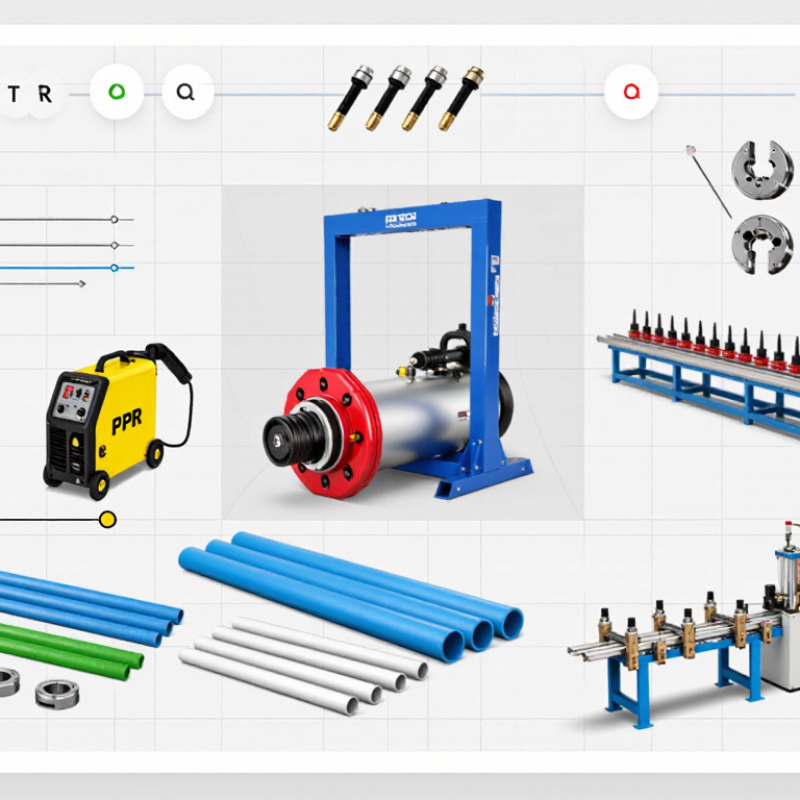
PPR Heater Machines Defined: ISO 15874 Pipe Systems and 20–160 mm Sizes
In 2026, PPR heater machines remain essential for reliable polypropylene pipe installation. ISO 15874 defines requirements for PP piping systems used in hot and cold water applications. It does not certify every heater machine. Buyers should match the machine with pipe sizes from 20 to 160 mm, joint design, and site conditions.
Manual socket-fusion heaters suit smaller pipes, especially 20–63 mm installations. They are portable, simple, and useful for repairs or apartment projects. Larger systems need stronger heating plates, stable clamps, and accurate alignment. Some machines support socket and electrothermal preparation, while specialized units handle bigger diameters. Temperature control matters. Uneven heat can soften one side too much.
From field experience, clean dies and steady pressure improve joint consistency. Measure twice. Cut once. Operators should check heating time, insertion depth, and cooling time for each diameter. A machine may display the correct temperature but still perform poorly after sensor drift. Calibration records, replaceable dies, insulated handles, and clear manuals deserve attention. The 160 mm range also exposes weak frames and loose clamps quickly. A perfect-looking weld can still contain hidden misalignment, so visual inspection alone feels insufficient.
2026 Top PPR Heater Machine Types for Global Buyers? - PPR Heater Machines Defined: ISO 15874 Pipe Systems and 20–160 mm Sizes
| Machine Type | Typical Outside-Diameter Range | Heating Method | Best-Fit PPR Applications | Typical Temperature Control | Operating Characteristics | Relevant ISO 15874 Context | Buyer Selection Criteria |
|---|---|---|---|---|---|---|---|
| Handheld Socket-Fusion Heater | 20–63 mm | Heated die and socket inserts | Domestic hot- and cold-water branches, repairs, maintenance, and small installation work | Thermostatic or electronic control; PP-R socket-fusion work is commonly performed near 260 °C, subject to the applicable procedure | Portable, compact, and suitable for confined spaces; requires correct dies for each pipe and fitting size | Used for jointing PP-R pipe and fittings covered by ISO 15874-2 and ISO 15874-3 | Check die accuracy, surface coating, temperature stability, electrical safety, and availability of 20–63 mm tooling |
| Bench-Mounted Socket-Fusion Machine | 20–110 mm | Fixed or swiveling heated plate with interchangeable socket dies | Workshop prefabrication, repeated fitting production, plumbing assembly, and medium-volume installation work | Adjustable electronic temperature control with visual or digital indication | Provides better alignment and repeatability than a handheld tool; requires a stable workbench and matched tooling | Supports socket-fusion assemblies for PP-R systems designed under ISO 15874 dimensional and performance requirements | Evaluate clamping accuracy, die-change time, heating-plate flatness, power supply, and operator ergonomics |
| Manual Hydraulic Socket-Fusion Machine | 40–160 mm | Heated socket tooling combined with a manual hydraulic clamping and alignment frame | Large-diameter building services, risers, plant-room pipework, and field installation | Controlled heated-plate temperature, commonly set around the PP-R fusion process requirement of 260 °C | Reduces manual alignment effort and helps maintain consistent insertion pressure for larger sizes | Suitable for larger PP-R pipe and fitting joints when the system design and jointing procedure comply with ISO 15874 requirements | Check maximum pipe size, clamping force, alignment range, hydraulic stability, transportability, and die coverage |
| Hydraulic Butt-Fusion Heater System | 63–160 mm | Heated plate positioned between prepared pipe ends, followed by pressure-controlled butt fusion | Long straight runs, industrial service lines, utility pipework, and applications where fittings are limited or unavailable | Electronic plate-temperature regulation; the approved procedure determines the exact heating and joining parameters | Requires pipe-end facing, controlled alignment, pressure management, and a qualified joining procedure | Confirm that the specific PP-R material, pipe construction, and jointing method are permitted by the applicable ISO 15874 system design | Assess facing quality, data logging, pressure control, plate coating, alignment tolerance, and operator training requirements |
| Multi-Head Socket-Fusion Station | 20–63 mm | Several heated dies arranged on one station or interchangeable heating head | High-volume assembly of manifolds, valve sets, distribution components, and prefabricated plumbing modules | Independent or shared electronic temperature monitoring, depending on the configuration | Improves productivity for repetitive joints; tooling must be matched to pipe and fitting dimensions | Used for repeated socket-fusion work involving PP-R components specified within ISO 15874 piping systems | Compare cycle time, number of simultaneous heads, die replacement, thermal uniformity, and maintenance access |
| CNC or Data-Assisted Fusion Station | 20–160 mm | Automated or semi-automated heating, alignment, and pressure sequencing | Prefabrication centers, quality-controlled production, industrial assemblies, and projects requiring traceable records | Closed-loop temperature monitoring with programmable process parameters | Can reduce process variation and record joint parameters; still requires compatible materials, tooling, and trained supervision | ISO 15874 compliance depends on the complete pipe system, materials, dimensions, joint procedure, and fitness-for-purpose evidence—not on automation alone | Review data export, calibration records, parameter locking, alarm functions, service support, and procedure qualification |
| Portable Battery-Assisted Fusion Tool | 20–63 mm | Portable electrically heated socket dies with battery or hybrid power | Remote maintenance, renovation, locations with limited mains power, and service work | Electronic temperature regulation with battery-capacity monitoring | Easy to transport and quick to deploy; available heating time depends on battery capacity, ambient conditions, and tool load | Joint quality must meet the relevant PP-R socket-fusion procedure for the ISO 15874 system | Check battery runtime, charging requirements, temperature recovery, die availability, weight, and protection against job-site dust and moisture |

Certified Quality System
 Find Your Solutions ▶
NORTH EASTON MACHINE • 218 Elm Street • North Easton, MA 02356 • 508-238-6219