2026 Top Clamp On Water Meter Suppliers for Global Buyers
Choosing the right Clamp On Water Meter supplier is no longer a simple price comparison. Global buyers must examine measurement accuracy, installation support, product traceability, and long-term service. A reliable supplier should understand municipal networks, industrial pipelines, irrigation systems, and temporary flow surveys. Each application has different risks.
Flow measurement analyst Jesse Yoder, Ph.D., has stated, “The best flow meter is the one that fits the application.” This principle guides our review of the 2026 market. A compact sensor may perform well on a clean, full pipe, yet struggle with air bubbles, heavy deposits, or unstable flow. Small details matter. Very much.
This guide evaluates leading Clamp On Water Meter suppliers through practical purchasing factors. These include pipe diameter ranges, sensor compatibility, battery life, data logging, communication options, calibration evidence, and technical response times. We also consider field experience, not only catalog claims. Can the supplier help select the correct transducer spacing? Can its engineers explain signal quality at the job site? Those questions reveal real competence.
Some comparisons remain imperfect. Public specifications are often inconsistent, and supplier websites may omit important limitations. That weakness deserves attention. Buyers should request test records, installation instructions, warranty terms, and references from similar projects. A low initial cost can become expensive after repeated troubleshooting. Conversely, a premium meter is not automatically better. Fit, support, and verified performance should decide the purchase. This overview helps global buyers create a clearer shortlist and avoid confident decisions based on incomplete information.
What Clamp-On Water Meters Are and How They Work
What Clamp-On Water Meters Are and How They Work
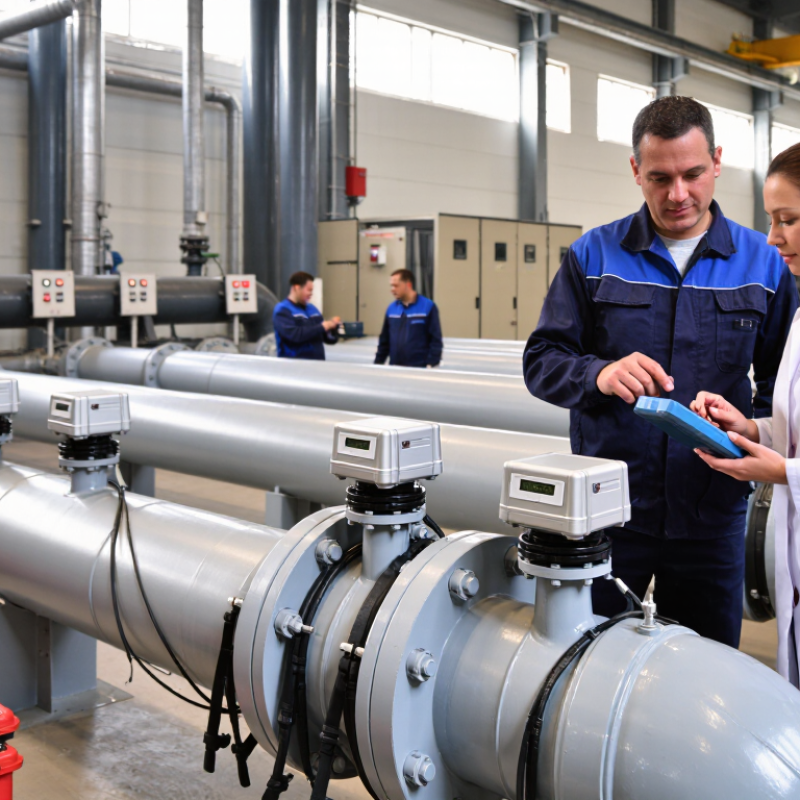
Clamp-on water meters measure flow without cutting or opening a pipe. External sensors attach to the pipe wall using straps or coupling gel. Most models use ultrasonic signals. One sensor sends a pulse downstream, while another sends it upstream. Flowing water changes the travel time between these signals. The meter converts that difference into flow rate and total volume.
This method reduces shutdowns, contamination risks, and installation labor. It suits municipal networks, industrial lines, irrigation systems, and temporary surveys. The UN World Water Development Report 2024 states that agriculture uses about 70% of global freshwater withdrawals. Accurate field measurement therefore matters, especially where irrigation losses remain unclear. The U.S. Environmental Protection Agency also reports that household leaks waste nearly one trillion gallons annually in America. Clamp-on measurement can help locate unusual consumption, but it cannot repair a damaged pipeline.
Tips: Clean the pipe surface first. Confirm pipe diameter and wall material. Keep sensors aligned and adequately spaced. Follow the manufacturer’s calibration guidance. Air bubbles, heavy scale, weak coupling, and disturbed flow can reduce accuracy. Straight pipe length is often overlooked. No field setup is perfect. A second reading at a different flow rate can expose questionable results. Record temperature, pressure, pipe condition, and installation position beside every measurement. These details make later verification more reliable.
How Clamp-On Water Meters Work: Calculated Transit-Time Difference
Clamp-on ultrasonic water meters measure flow from outside the pipe by comparing the travel time of ultrasonic signals moving with and against the water flow. The chart shows calculated transit-time differences for different pipe diameters under the same conditions: clean water at approximately 20°C, a flow velocity of 1 m/s, and a 45° ultrasonic beam angle.
Larger pipe diameters create a longer ultrasonic path, producing a larger measurable time difference. Actual readings vary with water temperature, pipe material, wall thickness, flow velocity, and installation conditions.
Key Features to Compare Among Global Water Meter Suppliers
Global buyers comparing clamp-on water meter suppliers should examine measurement performance before purchase price. Accuracy is not everything. Ask for evidence from controlled tests and real installations. Reliable suppliers provide flow-range data, repeatability results, and calibration records for each meter series.
Check whether the supplier supports your pipe diameter, material, lining, and water temperature. Stainless steel, ductile iron, and plastic pipes may require different sensor settings. A clear installation guide should show sensor spacing, coupling compound use, and signal checks. Details matter. Field experience shows that poor sensor placement can create unstable readings, even with advanced electronics.
Review the enclosure rating, display visibility, battery life, and communication options. Modbus, pulse output, or wireless access may simplify integration with existing monitoring systems. Confirm the supplier’s data format before ordering. Also compare technical support, replacement sensors, warranty terms, and delivery capacity across regions. A responsive engineer can be more valuable than a small discount.
Ask for evidence. Request sample reports, reference applications, and a written list of operating limits. Some suppliers describe broad compatibility without explaining limitations. That gap deserves careful questioning. A practical comparison should include total ownership cost, installation time, verification tools, and future service availability. Low prices can look attractive, but unavailable spare parts may stop a water line from being monitored when accuracy matters most.
Top Clamp-On Water Meter Suppliers for International Buyers in 2026
International buyers evaluating top clamp-on water meter suppliers in 2026 should begin with measurement conditions, not promotional claims. Clamp-on ultrasonic meters are useful for aging pipelines because installation usually avoids cutting, draining, or welding. The World Bank has estimated global non-revenue water at roughly 32 billion cubic meters annually, making dependable flow measurement commercially important. However, a supplier’s real value appears on difficult pipes, not polished demonstrations.
A capable supplier should provide traceable calibration, installation guidance, and performance data for varied pipe materials. Request accuracy results for cast iron, PVC, lined steel, and partially filled pipes. Check support for ISO 4064 or equivalent national requirements. Battery life, IP protection, temperature range, and data export also matter.
Small details matter here. A loose sensor can distort readings before anyone notices.
Grand View Research reported strong growth in the global smart water management market through 2030, driven by network monitoring and digital metering. That trend encourages more suppliers to enter international markets, but growth does not guarantee field competence. Buyers should ask for reference installations, calibration certificates, spare-part policies, and response times across time zones. A supplier may offer impressive software yet weak commissioning support. I would request a supervised site trial before purchasing large volumes. It costs more initially, but one failed measurement campaign can cost far more. No shortlist is perfect; local pipe conditions can expose assumptions that looked reasonable on paper.
How to Evaluate Meter Accuracy, Compatibility, and Certifications
For global buyers, evaluating a clamp-on water meter starts with measurement evidence, not a product brochure. Ask for accuracy results from an ISO/IEC 17025-accredited laboratory. Check the tested flow range, temperature, pipe diameter, and installation conditions. A meter rated at ±1% may perform differently on a partially filled or heavily scaled pipe. Field reality matters.
Compatibility is equally important. Confirm pipe material, outer diameter, wall thickness, liner type, and fluid temperature before ordering. Steel, PVC, ductile iron, and concrete pipes can produce different ultrasonic signals.
Mounting space also matters. Verify sensor cable length, enclosure rating, power supply, and communication protocol. Leave room for straight pipe sections where possible. Small details matter.
Certifications should match the destination market and application. Review calibration certificates, electrical safety documents, ingress protection ratings, and drinking-water contact approvals when required. Ask whether test documents identify the exact model and revision. Generic certificates create uncertainty.
I have seen a meter pass bench testing but struggle near a noisy pump. That result was disappointing, yet useful. Installation training, verification software, and local technical support can reduce similar surprises. Do not treat certification as proof of perfect field accuracy. It is evidence, not a guarantee.



 Find Your Solutions ▶